
The great ruined cities of the plate — Jiaohe, Gaochang — take the fame, and deservedly. But the ruin that visitors end up loving most is usually the smallest of them: Subash, north of Kuqa, where a monastery's earthen bones stand in open farmland and the evening light does something the big sites, fenced and boardwalked, no longer allow.
What stands at Subash.
Subash was a Buddhist monastery complex, built from the second century onward across two walled precincts on either side of a dry river channel. What survives is the grammar of the place rather than its fabric: two colossal stupas — cylindrical drums of rammed earth, once plastered and painted, now leaning like tired sentries — courts, cells, and the footings of walls that housed one of Kucha's great monastic communities. The site is open, unfenced inside, and small enough to know in an hour.
The monk who stayed.
The monastery's fame rests on a guest. In the 630s the monk Xuanzang — walking from Chang'an to India in the journey that would become the Great Tang Records and, a millennium later, a novel with a monkey in it — stayed at Subash for two months, debating scripture with the Kuchean masters before crossing the passes. The site's little museum makes the most of the connection, and the connection is genuinely moving: the pilgrim's route is the caravan route with a different cargo, and Subash is one of the few places you can stand in a building he named.
The honest material.
All of it is earth. Rammed earth cores, mud-brick superstructure, plaster skin — the monastery was built of the ground it stood on, which is precisely why it stands at all in this climate and precisely why it is dissolving now. The conservation philosophy, visibly, is stabilization rather than reconstruction: props under the leaning stupas, capping on the wall-cores, nothing prettified. Subash looks the way a fifteen-hundred-year-old mud building honestly looks, and the honesty is the attraction.
The hour before sunset.
Earth buildings live or die by raking light, and the hour before sunset at Subash is the best on the northern arc. The stupas go from grey to amber; the wall shadows sharpen; the farmland beyond the precincts — sunflowers, in season — carries the colour outward. Our routes time the stop for that hour, which also happens to be the hour the site empties: the tour coaches run to the canyon in the afternoon, and the monastery is left to the evening.
Fitting the stop in.
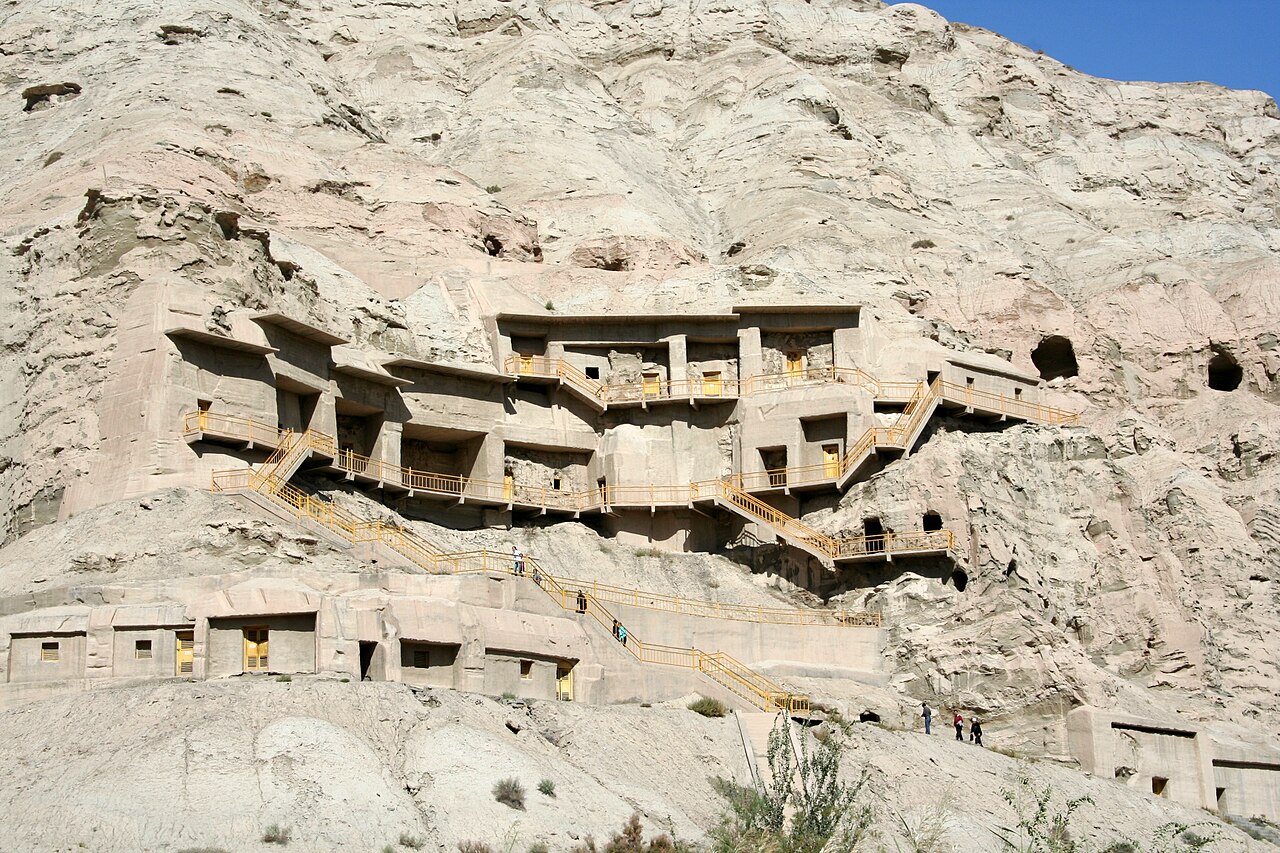
Subash pairs naturally with the Kizil caves — monastery and painted cliff in one arc west of Kuqa — or as the morning-before for the canyon. On the flagship route it is the quiet hour between the Duku highway's noise and the desert crossing's emptiness. Guests remember it as the stop where nothing was scheduled and everything happened: a leaning stupa, a long shadow, and the pilgrim who slept here on his way to India.
Where this leads
Way stations of the silk road
Kizil: the earliest painted caves
Guide: Korla & Kuqa