
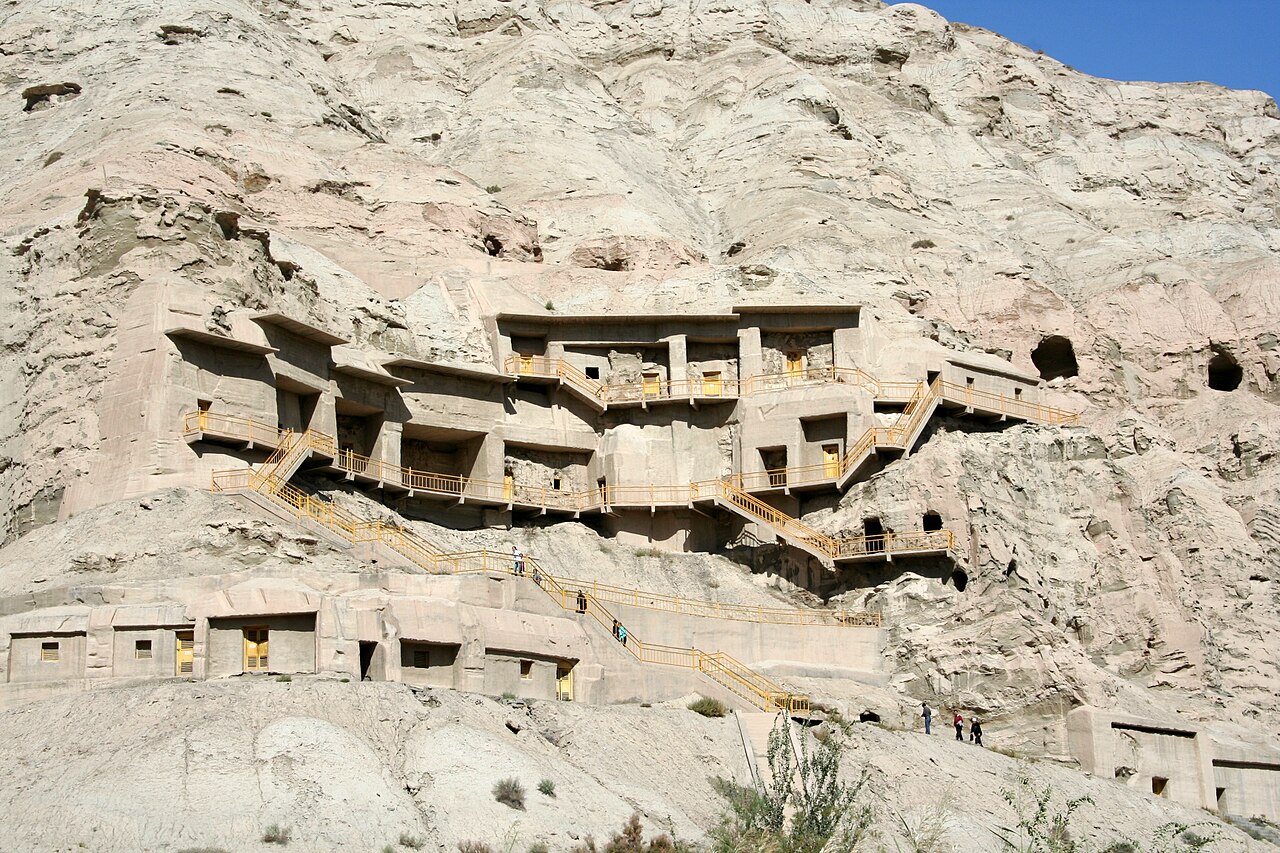
Two hours west of Kuqa, where the Muzart river exits the mountains, a sandstone cliff carries a grid of openings like a giant's honeycomb. This is Kizil — begun in the third century, painted continuously for five hundred years, and the earliest major cave complex in China. It is also, by a distance, the most quietly devastating visit on the plate, for reasons the cliff itself makes plain.
The cliff and the grid.
The caves number more than two hundred and thirty, cut into the cliff face in terraces and linked by walkways rebuilt for visitors. From the riverbank the grid reads as architecture — chanting halls, cell quarters, and the square-pillared stupa caves that are the complex's signature form. The setting does half the interpretive work: this was a working monastery above a river crossing on the northern caravan route, funded by the merchant traffic it watched, for the length of the first millennium.
Five centuries of painting.
The painting spans roughly the third to the eighth centuries, and scholars divide it into phases that visitors can genuinely see: the earliest work with its strong Indian and Gandharan inheritance; the classic Kuchean phase, with its sinuous line, blue-and-green palette and round-faced donors; and the later phases where Tang influence arrives from the east. The sequence is a visual history of the silk road's first half millennium — painted in one cliff.
The ceilings worth the trip.
The masterpiece form at Kizil is the barrel ceiling: a tunnel vault painted in diamond-shaped compartments, each holding a figure — a Buddha, a bird, a musician, a mountain spirit — in a brilliance of lapis and malachite that five centuries of lamp smoke have not dulled. The blues came from Afghanistan by caravan, which makes the ceilings themselves an argument for the road that made them possible: the most expensive pigment in the ancient world, spent on a barrel vault above the desert.
What the expeditions took.
And then the honesty that any Kizil visit requires: the early twentieth-century expeditions from several countries cut the murals out of the walls in sawn rectangles, and the best of them now hang in museums in Berlin, Paris, Tokyo and St Petersburg — some of the Berlin panels destroyed in the war that followed. The cliff is covered in the wounds of that sawing. A good guide does not hide it; the empty rectangles, many labelled with their present addresses, are the cave's second, harder lesson.
How to visit well.
Access is ticketed and guided, with a rotating set of caves open at any time; photography is barred. Visit in the morning light for the valley, wear shoes for stairs, and — the decisive choice — take the guide seriously: the open caves rotate, and a guide who knows the current selection can show you a classic-phase ceiling instead of a later corridor. Budget two hours; the site rewards slowness more than any other single stop on the route.
Where it sits on the route.
Kizil sits a half-day west of Kuqa on the northern arc, and our flagship route reaches it on the crossing between the Duku highway and the desert — caves in the morning, the canyon's red rock in the afternoon. Guests arrive with the mummies of Urumqi and the ruins of the oases already seen; at Kizil the road's story turns from trade to belief, and the plate shows its third face: the one it painted on ceilings, in imported blue.
Where this leads
Way stations of the silk road
Guide: Korla & Kuqa
The Xinjiang silk road flagship