
Bread is the constant of the plate. Rice owns the far south-west of China, noodles own the north-west — but Xinjiang, sitting on the old caravan road between them, eats naan, and it eats naan everywhere: for breakfast with tea, at noon stuffed with lamb, wrapped around melon on a long drive, dried in the sun for a journey that might last a month. Every town bakes, and no two towns bake alike.
The oven makes the bread.
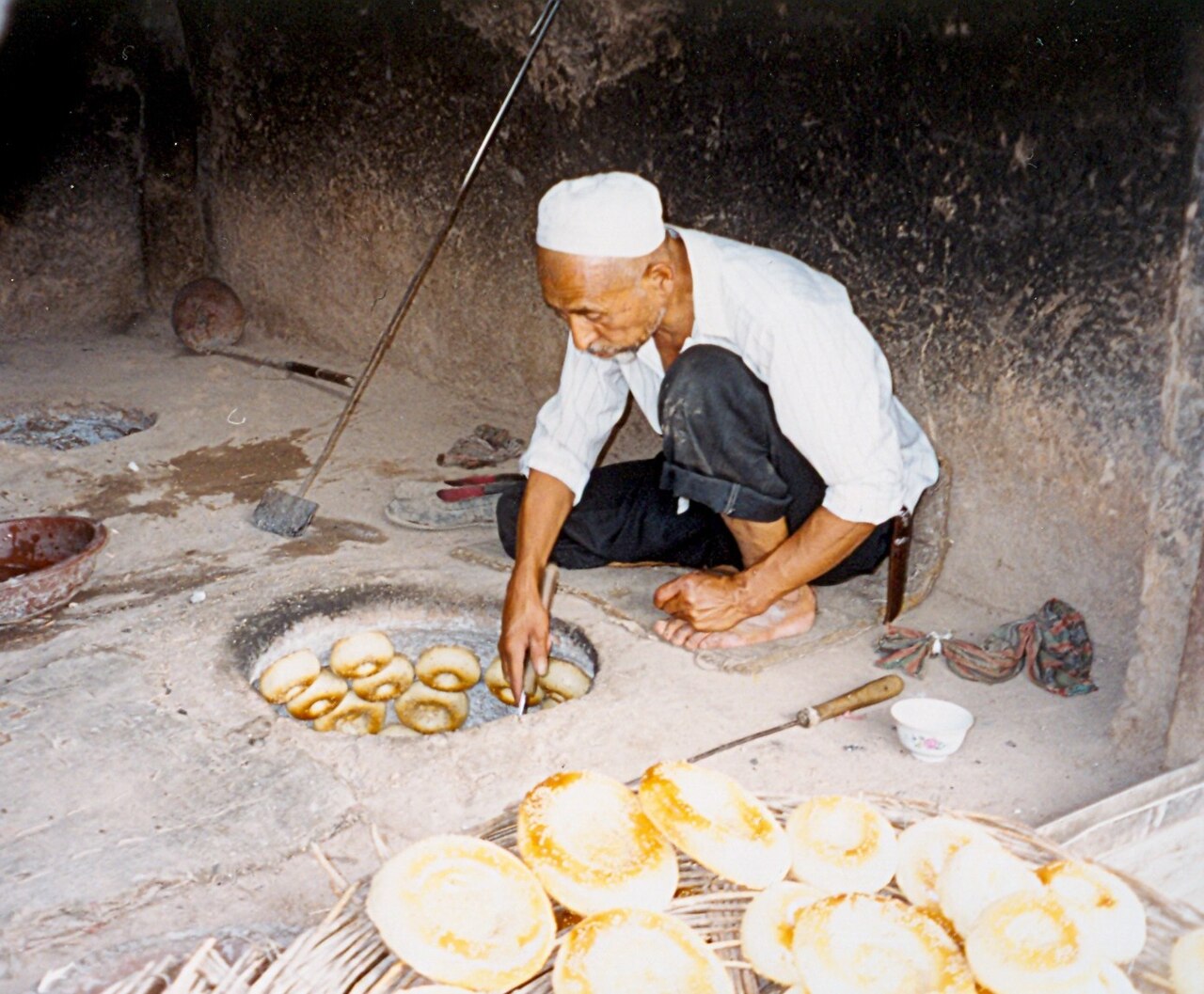
All of it comes from the tandoor — a clay urn, fired to the temperature of a furnace, into which the baker slaps the flattened dough and lets it hold on the wall. The shape of the oven dictates the shape of the bread: round, of course, but also thick-bottomed and thin-topped, because the part that touches the clay chars while the upper crust bakes in the trapped fire. The dimpled, sesame-scattered face of a naan is decoration only in part; the pin-pricked centres keep the bread flat as it bakes.
A field guide to the kinds.
Kashgar bakes thin, crisp rounds the size of a dinner plate, stacked in towers at the stall. Turpan favours a softer, thicker loaf with a dense crumb, built for the vineyard lunchbox. Hotan's naan runs large and faintly sweet, sometimes with onion oil worked through. The travelling bread of the desert oases is baked hard enough to be packed for weeks — softened over flame or crumbled into broth, it is the original road food of the caravans.
The Kuqa exception.
And then there is Kuqa. The old town on the northern edge of the desert bakes a naan the size of a bicycle wheel — korra naan, half a kilo of bread with a rim of crust and a centre of seed-flecked crumb, sold whole at stalls that have presumably never once considered a smaller format. A single one feeds four people at a roadside table and makes the best possible lunch between the Kizil caves and the canyon.
One baker, four hundred loaves.
Watch any neighbourhood oven for ten minutes and the arithmetic stops surprising. A baker alone — usually alone — turns out several hundred loaves in a morning shift, each slapped into the furnace, turned, hooked out and stacked. The dough was made the night before; the queue started before dawn; the day's bread is sold out by ten. The city then runs on it until the ovens light again at four.
How to eat it, practically.
The honest advice: eat naan the day it is baked, and prefer the stall with a queue of workmen to the stall with a display shelf. Buy a quarter, not a whole — the towers are priced to sell by the loaf and the loaf is priced to travel. And on any long drive, take one for the car; the plate's distances were crossed on this bread, and the road has not improved on it since.
Where this leads
Guide: eating the plate
The oasis kitchens
The caravan road