
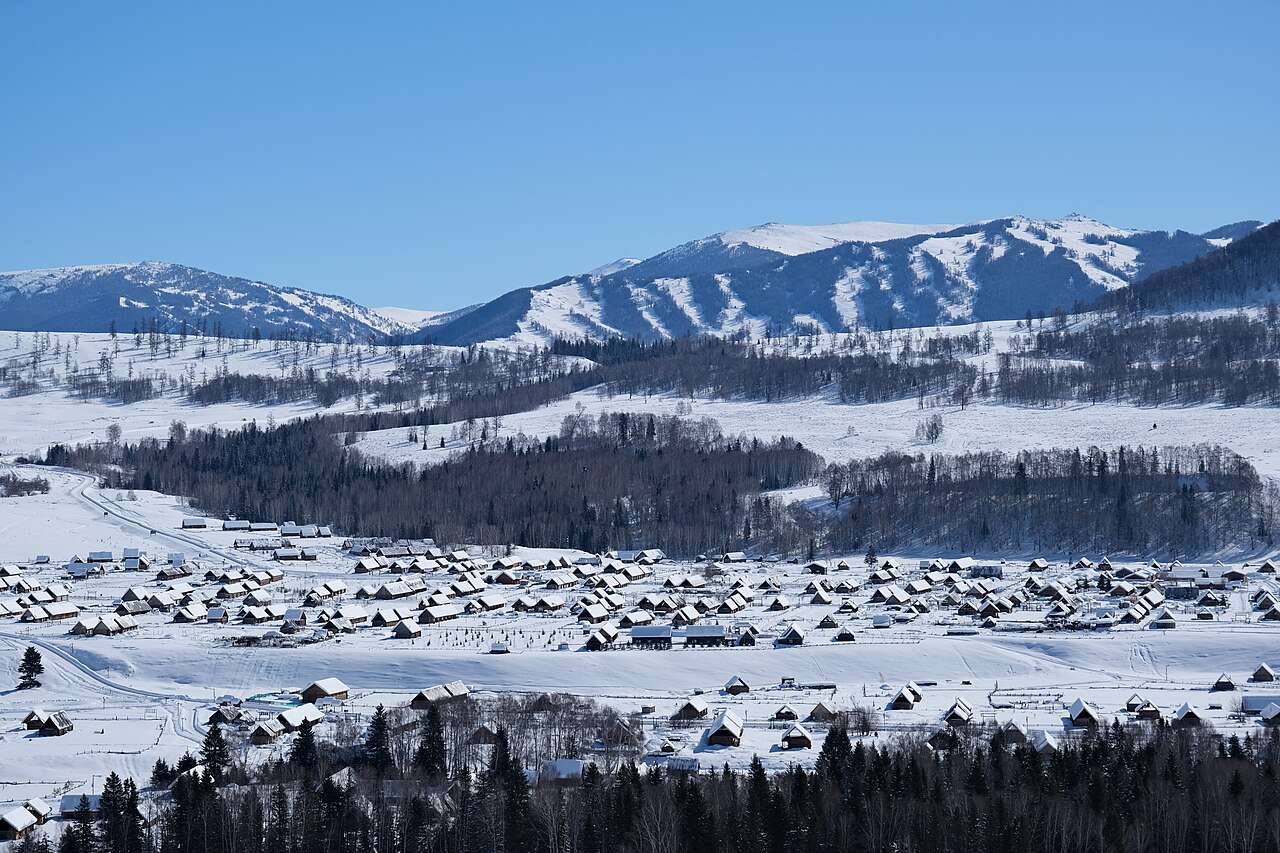
The Altai in winter is the coldest place in China where people live all year — readings past minus thirty are routine in the basin towns, and the valley roads run through country that has finished pretending otherwise. Yet the region's winter journeys are among the most reliable on the site, because everything about them is built on an honest reading of what the roads do.
The cold, by number.
The numbers first, because they shape everything: December and January nights in the cities run minus twenty to minus thirty; the mountain basins go lower. Dry cold at that level is more workable than damp cold at half the number — snow squeaks underfoot, engines plug in overnight, and the sky, on clear days, is the high hard blue that winter photographers cross provinces for. Days are short at this latitude; the useful light runs roughly ten to five, and it is golden for much of it.
What is kept open.
The trunk roads — the airport links, the city-to-city highways, the valley road to Hemu — are ploughed and sanded through the season as a matter of civic obligation; the towns on them are not optional to reach. What closes, repeatedly and without apology, is everything above them: the passes, the forest tracks, the side valleys. The road up the mountains to the big resorts is maintained as a priority corridor because the resorts are the region's winter economy.
Storm days, and the buffer.
Siberian storm cycles sweep the range every week or two in deep winter, and a cycle can drop a metre of snow and close a valley road for a day. This is not a risk to be managed away; it is the season's weather, and the journeys are designed around it. Our ski week holds a buffer night in the city at the far end — so a storm that closes the valley road costs a hotel sauna and an unplanned powder morning, not a flight. Guests who understand this spend the buffer gladly; guests who fight it should come in autumn.
How the journeys actually move.
Winter driving on the plate's north is done by local drivers, in vehicles kitted for the season, on schedules that start after the ice fog lifts and end before dusk. The distances are honest: city to resort, an hour or two; city to the big mountains, most of a day. Nobody drives the valley road at night, and the horses take over where the ploughs stop — in Hemu, winter transport inside the village is still sledge and horseback, and it is part of why the village is the journey's quiet centrepiece.
Building the winter week.
The shape that works: arrive and acclimatise with city powder at Jiangjunshan, cross to the big mountains at Koktokay for the verticals, finish in Hemu with the buffer behind you. Late October to early April is the season; the deepest, most reliable snow runs December to February. Guests who build the buffer in get the winter that locals get — and the storm morning, when it comes, tends to become the story they lead with.
Where this leads
First snow in Hemu
The Altai ski week
Season board: the snow report