Kanas & the three bends
Kanas lake fills a glacial trough at 1,374 m; downstream, Wolong, Moon and Shenxian bends form three of the finest dawn compositions in China. Our eight-day photo journey holds three nights at the lake.
 Start your enquiry
Destinations / Xinjiang / The Altai north
Siberia starts here: larch forest, glacial rivers, wooden villages and the deepest snow in China. Autumn owns this region for two golden weeks; winter owns it for six months.
Explore the guide ↓Northern Xinjiang · Altai prefecture
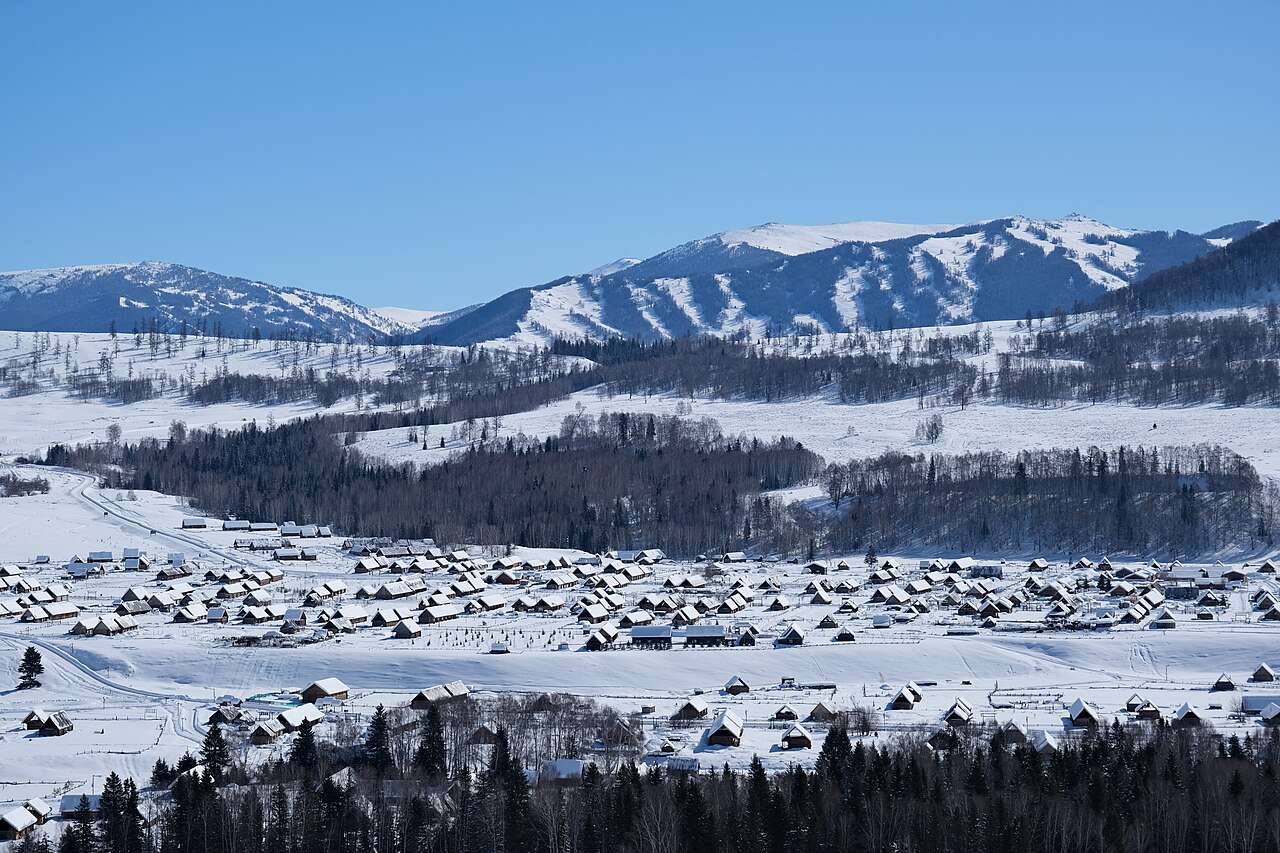
The Altai is where China stops looking like itself. The forests are Siberian larch and birch, the rivers run milky turquoise out of glaciers, and the villages — Hemu, Baihaba — are timber settlements of Kazakh and Tuva families, log-built against winters that arrive in October and leave in April. Rock art near the city of Altay depicts skiers four thousand years old; the region calls itself the birthplace of skiing and, uniquely among China's claims, the evidence is carved in stone.
Geographically the north is a three-layer stack. The Gobi rim at the bottom: the Wuerhe yardangs, wind-carved red cities of sandstone, and the long drives between everything. The forest belt in the middle: Burqin on the Irtysh, the valley roads, the fruit and fish country. And the high Altai on top: the Kanas basin, its lake and three great river bends, the ridgelines that carry snow from November to May.
Season decides everything here, more starkly than anywhere else we run. June is the meadow month and belongs to trekkers; the last fortnight of September is the gold window and belongs to photographers; November to April belongs to skiers, with the driest powder and the longest lift-served verticals in the country. The north in shoulder season — May, August — is beautiful and quiet and second-best at both.
The region's essential landscapes, and the journeys that work them.
Kanas lake fills a glacial trough at 1,374 m; downstream, Wolong, Moon and Shenxian bends form three of the finest dawn compositions in China. Our eight-day photo journey holds three nights at the lake.
Wooden houses, grape-drying eaves in autumn, horse-sleds on the frozen river in winter — the last villages of their kind in China, best worked slowly with a village overnight.
Jiangjunshan inside Altay city, Koktokay's granite gorge, Jikikpulin's 1,466 metres of vertical above Hemu — three resorts, one week, no queues.
Yardang landforms carved from red sandstone by a wind that never stopped — between the mountains and Urumqi, at its best in the last hour of light.
The only Chinese river that runs to the Arctic ocean; its Burqin reach feeds a grilled-fish culture worth planning a dinner around.
Four different norths, by season.
Peak larch colour, village mornings with fog on the river, and the year's first high snow. The fortnight shifts with the weather; we confirm realistic timing before flights are booked. Crowds are real — our routes are built around dawn sessions and the quiet corners.
Wildflowers across the valley pastures, everything green, stable walking weather. Quieter than autumn and the best trekking light.
Resorts open from late October; prime powder December to February; March brings warmth and long days. Hemu village becomes a snow hamlet, access permitting.
May and August sit between windows — lovely, quiet, and not what the postcards sell. If your dates are fixed to those months, we will tell you honestly what the region gives back.
Distance is the region's tax — plan the line, not the dots.
Urumqi is the gateway: frequent flights to Altay city (the ski gateway) and daily ground access to Burqin. The classic road journey Urumqi–Burqin–Kanas–Hemu runs 600-plus kilometres; our itineraries do it as a line, not a loop.
The Kanas and Hemu zones manage access with zone tickets and vehicle restrictions — private vehicles stop at the gates. Staying inside the zones at dawn costs more and buys the light; it is the single best call on an autumn trip.
Storms can close village roads for a day or two at a time. Winter itineraries flex around closures rather than fight them, and travel insurance with winter-sports cover is required — we check it before departure.
Kazakh and Tuva lifeways, and the region's table.
Herder skis — pine boards with horse-hide skins, fur lying backwards for grip on the climb — are still made and used. Villages demonstrate them in winter; respect that this is working equipment with a history, not a costume.
Milk tea, hand-pulled noodles, roasted lamb and the region's dairy: the winter table is built for the cold, and guests eat what the household eats.
Villages are homes, not sets. Ask before portraits, buy from the households that host you, and keep dawn sessions on the platforms rather than in private yards.
The details worth discussing when shaping your trip.
Winter in the Altai reaches −30 °C. Our winter kit list is non-negotiable: layers, storm shell, spare batteries (they die in the cold), and the guide's call on outdoor time in extreme spells.
The gold fortnight books out early — village beds are few. Enquire three months ahead for autumn, two for winter holidays.
The north pairs naturally with the east: Turpan is winter-walkable exactly when the Altai is snowed in, and the two make a classic autumn-plus-winter pair.
Tell us your season — gold, green or powder — and we will shape the north around it, with the colour and snow outlook checked before you book anything.
Start my journey brief ↗