Tarboche and the west face
The circuit opens at the flagpole plain of Tarboche, where the horse-year flag raising is the region's great ceremony.
 Start your enquiry
Trekking / Mount Kailash · The kora
Fifty-two kilometres around the most circumambulated mountain on earth: a circuit walked by four religions, measured in prayer flags, and closed by a pass higher than any mountain in the Alps.
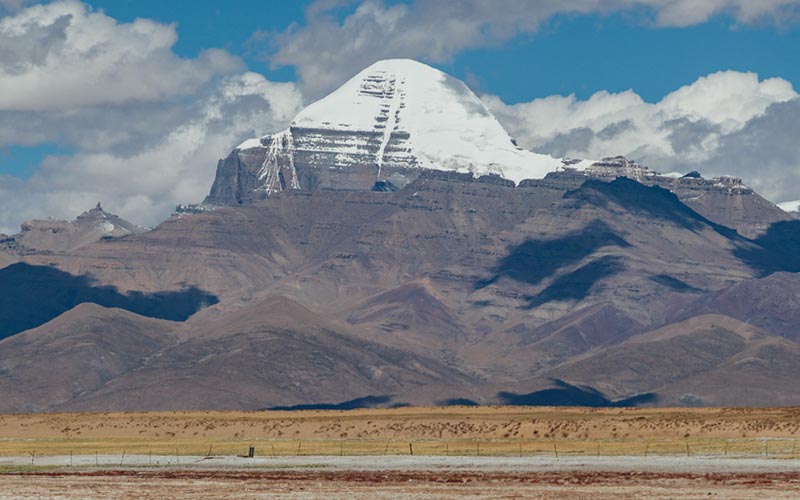
Start this route briefTibet · The south face of Kailash from the Barkha plain
Mount Kailash — never climbed, sacred to Buddhists, Hindus, Jains and Bön, and the source concept for four of Asia's great rivers
around the mountain's base, walked clockwise by Buddhists and Hindus and counter-clockwise by Bön pilgrims
the Dolma La, the kora's high point and its ceremony — a prayer-flag summit crossed in a single morning
is the modern standard; pilgrims on full devotion walk it in one, and the prostrating take weeks
No mountain on earth is walked around more. Kailash is the axis of the world to Hindus, the abode of Demchok to Buddhists, the site of enlightenment to Jains and the soul of Bön — and for a thousand years the answer to all four has been the same: do not climb it, walk around it. The kora that results is the most extraordinary trail in China: a fifty-two-kilometre circuit at altitudes between 4,600 and 5,630 metres, lined with mani walls, chortens and prayer flags, shared with pilgrims for whom each step is counted prayer.
The modern standard is two days: the north face at Dirapuk for the first night, the Dolma La pass on the second morning, the eastern valley after, and the return across the Barkha plain to Darchen. This page walks it stage by stage. The mountain's background, permits and approach live on the main Kailash page.
A calendar note that changes everything: 2026 is a horse year in the Tibetan calendar — Kailash's own zodiac year, when one circuit counts for thirteen. Pilgrim numbers will be the largest in twelve years, the trail's teahouses will fill nightly, and the meaning of walking it multiplies accordingly. Plan early, walk humbly, and expect company on the pass.
Two walking days, one pass, and the most visited horizon in Asia.
The circuit opens at the flagpole plain of Tarboche, where the horse-year flag raising is the region's great ceremony.
The first day ends opposite Kailash's north face — the mountain's most perfect, most photographed wall, two kilometres of vertical gold at dawn.
The second morning climbs past the Shiwa Tsal charnel ground to the pass — a chaos of flags, clothing offerings and tears.
Below the pass the green lake of Gauri Kund, then the long third-valley descent and the plain walk back to Darchen.
The circuit starts from the pilgrim guesthouses at Darchen and walks west across the plain to Tarboche, the flagpole meadow where every horse year the great flag rises. Chortens line the path from the first hour.
The trail enters the Lha Chu valley and climbs gently past the Chuku gompa to Dirapuk monastery at 5,080 m. The afternoon belongs to the north face: the wall appears between ridgelines and then simply takes over the sky.
The second day starts in the dark for most pilgrims. The trail climbs the moraine past the Shiwa Tsal charnel ground — where pilgrims leave a piece of clothing, a nail, a drop of blood, an old self — to the pass at 5,630 m.
The descent from the pass is long and loose, past the green eye of Gauri Kund and down the east valley to Zutulpuk monastery. The hardest hours are over by lunch.
The closing walk: the eastern valley flattens onto the Barkha plain and the circuit returns across open ground to Darchen, with the mountain's south face ahead the whole way — the view you finish with, and the one that lasts.
Most travellers rest a day at Darchen or Lake Manasarovar before moving on — the circuit at this altitude is a full-body event, and the lake is the right place to be still about it.
The kora is a pilgrimage first and a trek second: the walking is straightforward, the altitude is not. Two nights of acclimatisation on the way in — Ngari is 4,500-metre country — are the difference between a ceremony and an evacuation, and we build them into every itinerary.
Walk with the pilgrims rather than around them. The clockwise direction is shared; the tea houses in the valleys are pilgrim infrastructure, basic and warm; and the horse year's crowds are not an obstacle to the experience but most of it. Start early both days, carry cash for the valley teahouses, and treat the Dolma La the way the pilgrims do — as a threshold, not a viewpoint.
And leave the summit ambitions at home. Kailash has never been climbed; every government that has governed this region has kept the ban, and the mountain's meaning depends on it. The kora is the summit.
May to mid-October; the horse-year summer will be busiest around the Sagadawa full moon in late May and June.
The circuit lives between 4,600 and 5,630 m — acclimatisation nights en route are not optional and we schedule them.
Pilgrim guesthouses at Dirapuk and Zutulpuk; Darchen has the better beds before and after.
The Ngari region needs the Tibet travel permit and military-area paperwork — arranged with the trip, never solo.
Yaks carry the rest on supported departures.
The second day begins at two in the morning, because the pilgrims do. The trail up from Dirapuk is a river of headlamps and murmured mantras, switchbacking through the dark toward a pass you cannot see — only feel, by the slope, by the cold, by the thinning air.
Then the Shiwa Tsal charnel ground, where the pilgrimage's oldest rite happens: pilgrims leave a token of the old self — a haircut, a garment, a tooth — and some prostrate their whole bodies up the final slope, rising and lying, rising and lying, the whole two kilometres of it.
The Dolma La at dawn is a storm of prayer flags, and the emotion on it is unguarded: Tibetans weep, Hindus sing, and everyone touches the great stone. From there the trail drops past the green lake and the day becomes ordinary again — which is, the pilgrims say, the point. The old self stays on the pass. You walk down lighter.
Fifty-two kilometres around a mountain that has never been climbed, and the walk itself is the answer.
We run the kora with full acclimatisation staging, pilgrim-guesthouse nights and Ngari permits arranged — in the horse year especially, beds on the circuit are planned months ahead. Most itineraries pair the mountain with Lake Manasarovar and the Guge kingdom.
The Mount Kailash guide · The Ganden–Samye trek · The Kangshung valley · Shishapangma
Start a route brief