Three peaks, one valley and a very short window of good light each day. Almost every disappointing Yading photograph is a timing problem rather than a gear problem — the mountain was in the wrong light, or you were on the wrong side of the valley for it.
Three mountains, three faces, and a valley that runs the wrong way for two of them.
Yading's three peaks stand in a rough triangle around a glacial valley, and they do not face the same direction. Xiannairi's north wall looks down the valley towards the monastery; Yangmaiyong's pyramid faces south over the Luorong pasture; Chanadorje presents an east face above the Chonggu grassland. That single fact explains most of the light in this valley, and most of the frustration.
The second fact is the schedule. The reserve opens at seven, the first shuttle reaches the valley floor around 08:20, the long route has a 14:30 control point and the last cart down leaves at 16:30. Your photographic day is therefore two hours long at each end, with six hours of flat white light in between.
Where to stand, and for what.
The four positions that do most of the work, with the honest timing.
Position
Height
What it gives you
When
Pearl Lake (Zhuomala Tso)
4,080 m
Xiannairi reflected whole, with the lake as a mirror when the wind drops
07:40–09:00, before the tour groups and before the breeze
Chonggu meadow
about 3,900 m
Chanadorje across the grassland, larches on both flanks
Late afternoon to sunset; the east face lights last
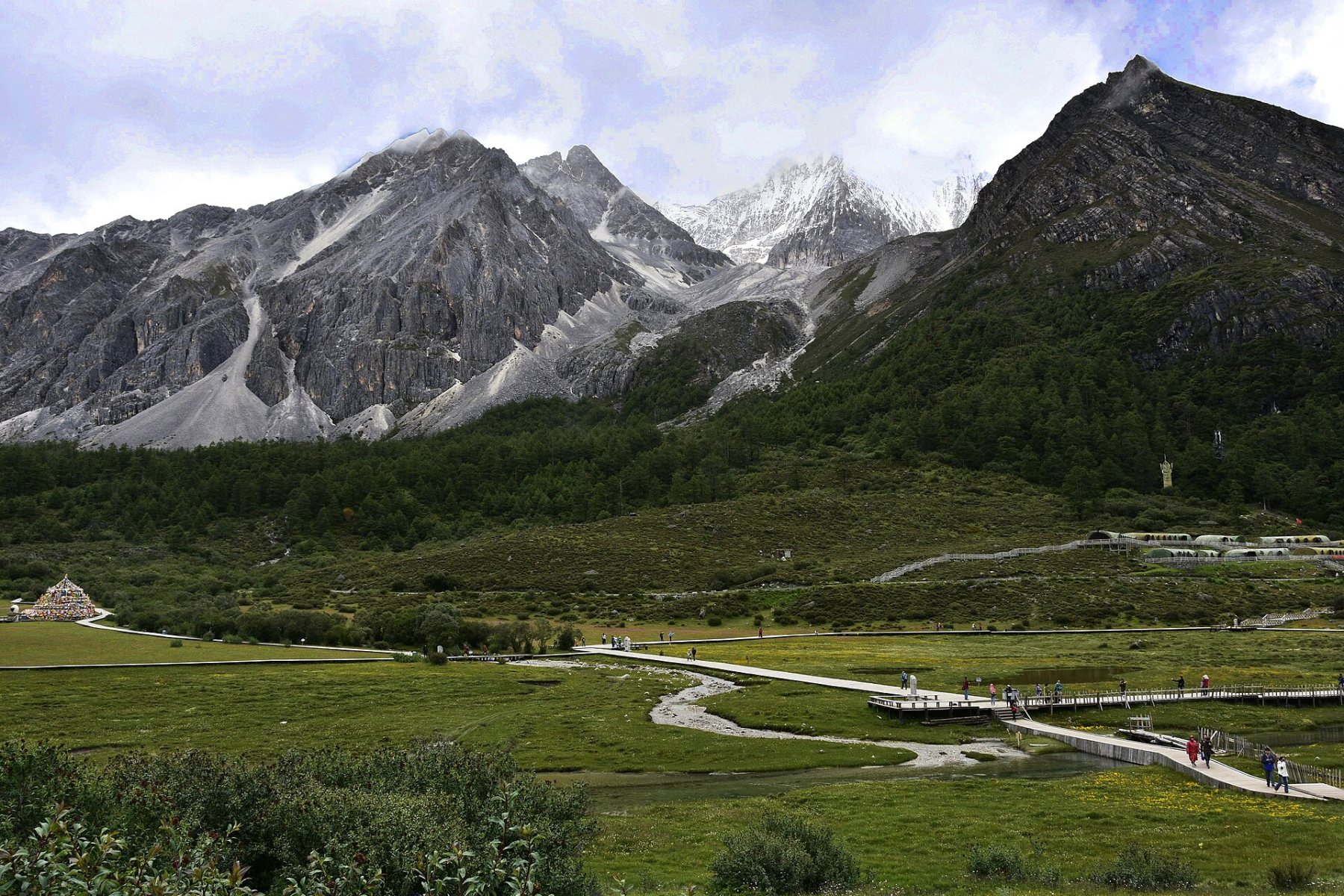
Luorong pasture
4,150–4,180 m
Yangmaiyong's south face, the stream and the boardwalk as leading lines
Sunrise side-light, and again in the hour before the last cart
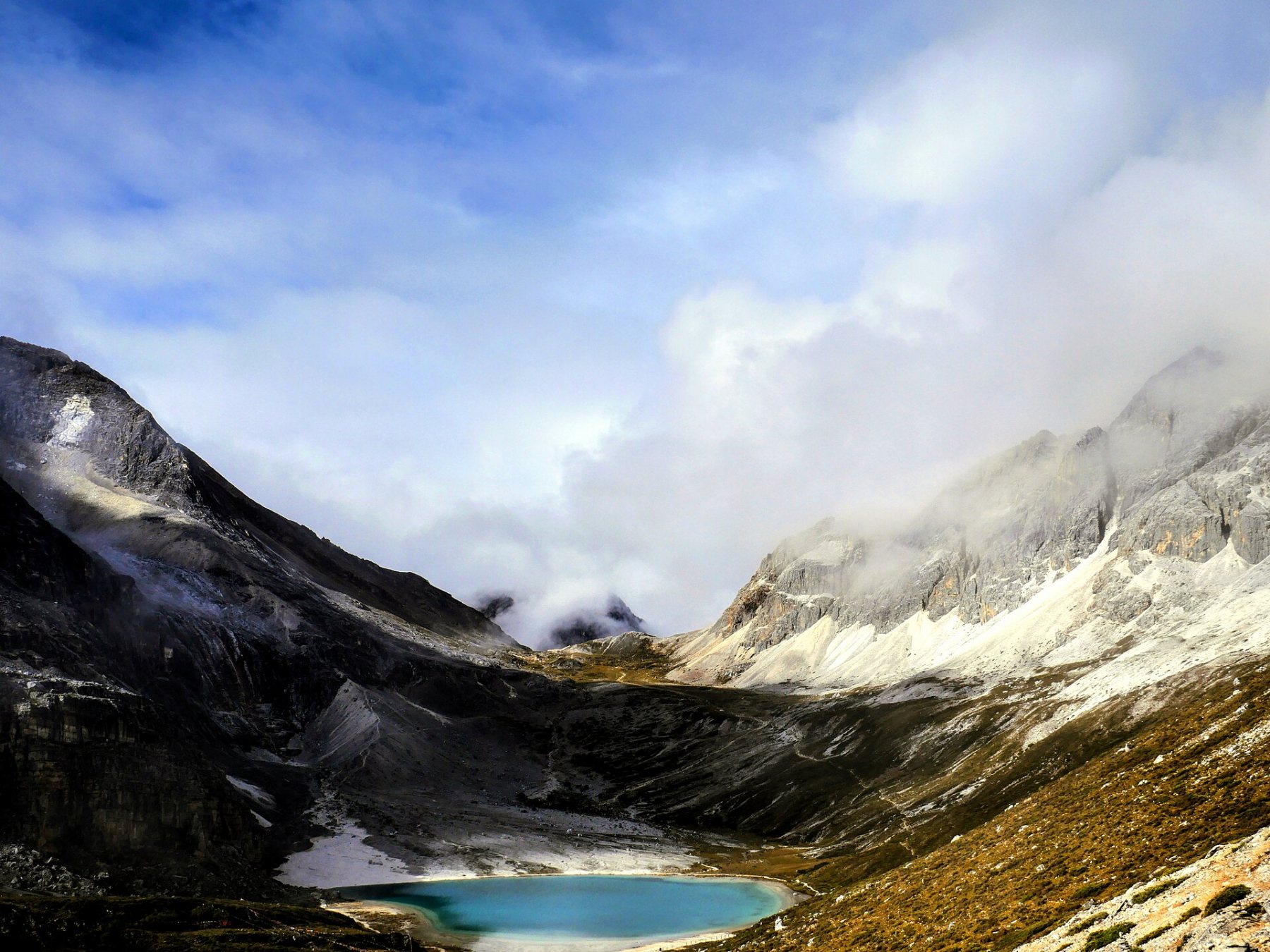
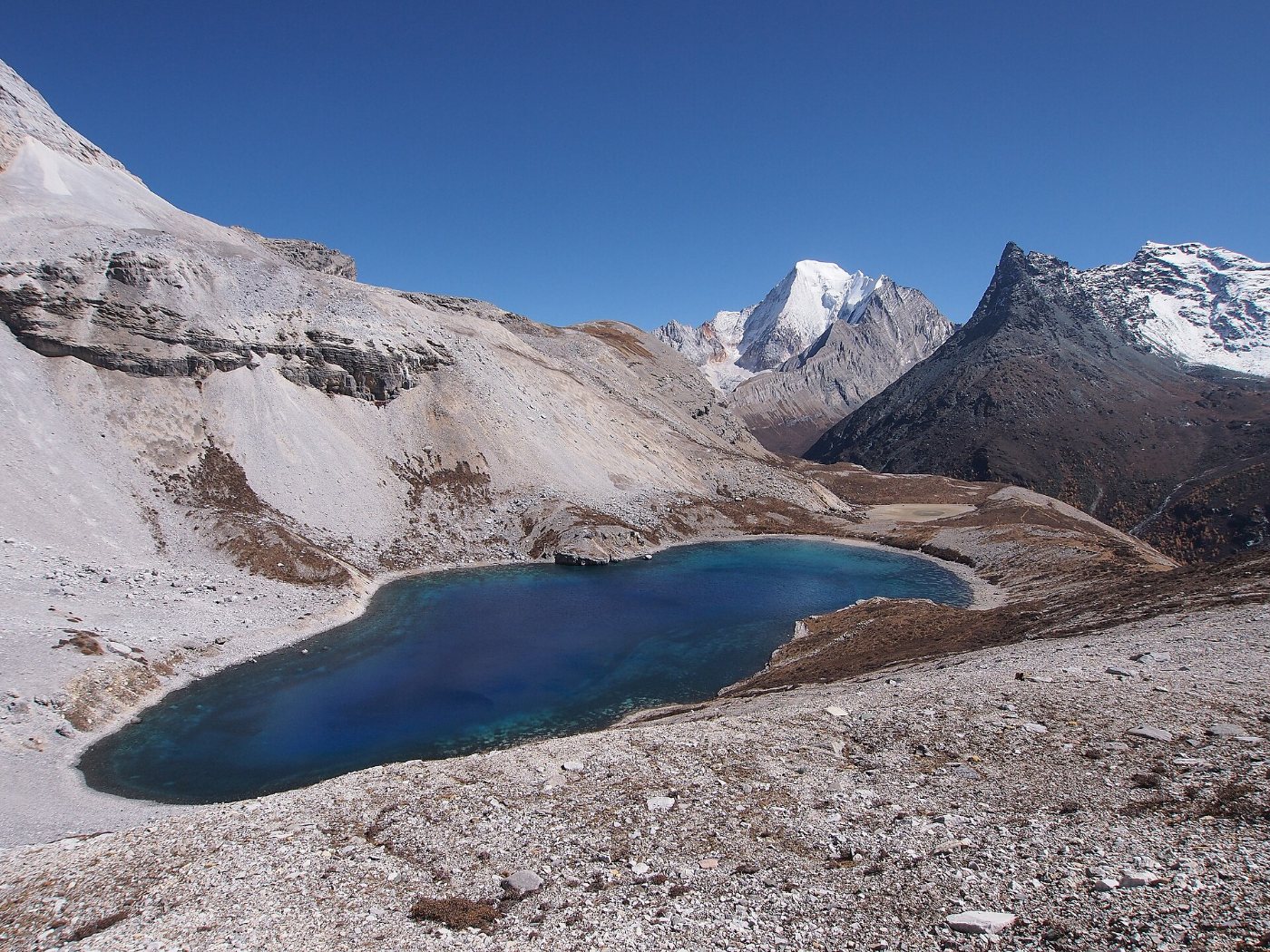
Milk Lake and Five-Colour Lake
4,600 and 4,700 m
The high basins, the cirque walls, the colour of the water
Late morning for depth of colour; by noon the basins are flat
Which peak is lit, and when.
The compass work that decides your day.
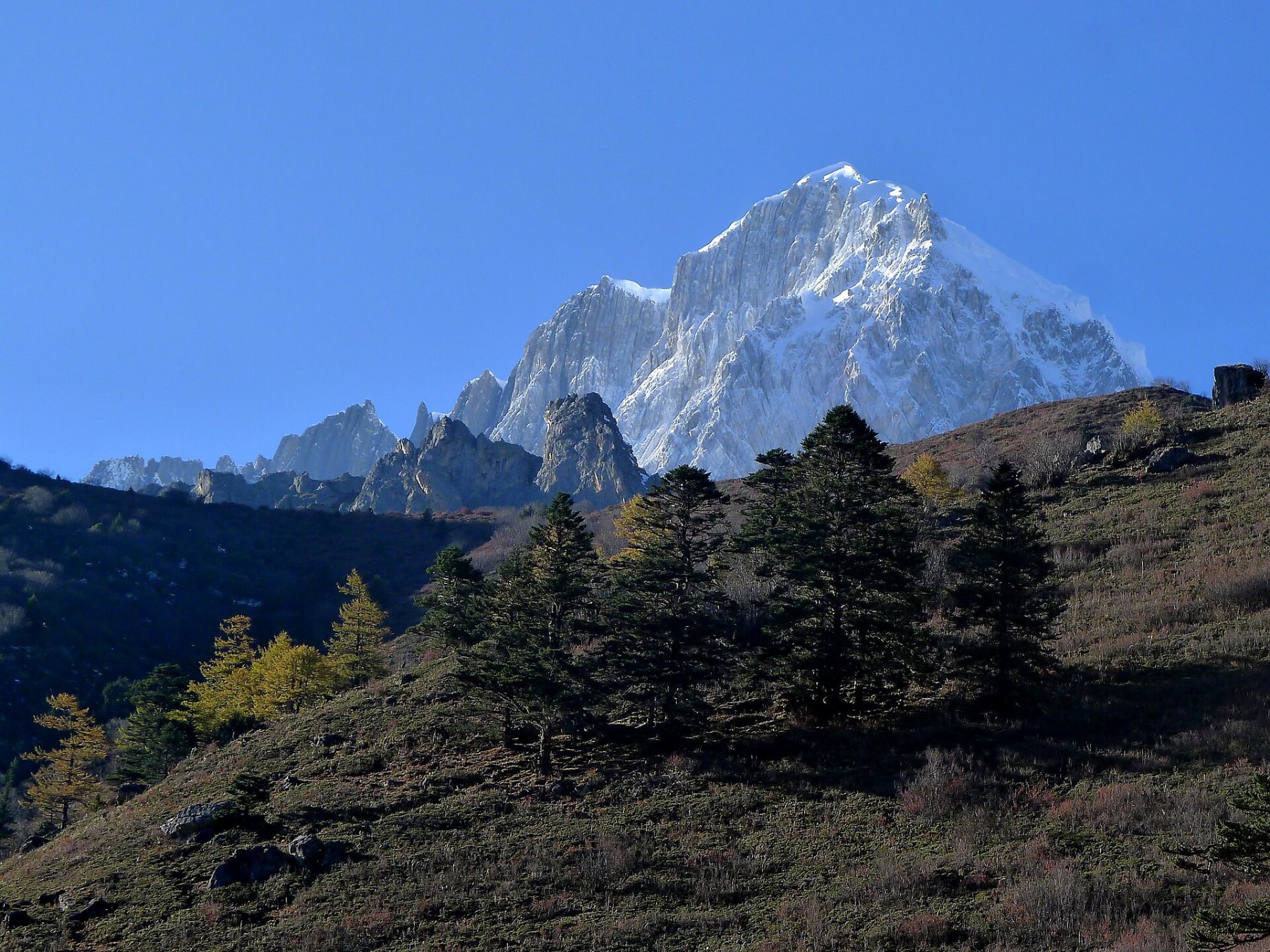
Xiannairi, 6,032 m, the north peak
Its north wall faces down the valley, so it is lit from the east in the morning and loses the sun early in the afternoon. Pearl Lake sits directly below it. The reflection is best in the first hour after the valley floor receives light — roughly 08:00 to 09:00 in autumn — because the lake is sheltered and the wind arrives later than the sun.
Yangmaiyong, 5,958 m, the south peak
The pyramid faces south, which means the Luorong pasture looks straight at it. Morning gives a clean side-light on the east ridge; late afternoon softens the face and fills the stream with sky. This is the peak Joseph Rock called the most beautiful mountain he had seen, and it photographs like a set piece: isolated, symmetrical, no clutter.
Chanadorje, 5,958 m, the east peak
The east face above Chonggu catches the last light in the valley. In the afternoon the grassland in front of it is in shadow while the summit is still lit, which is the shot everyone wants and almost nobody times correctly: be in position an hour before sunset, not at sunset.
The composition problem
Yading is bigger than it looks and the scale collapses in wide lenses. The fix is foreground — a cairn, a prayer-flag line, the boardwalk, a larch trunk — and a longer lens than you think. A 70–200 mm used at 100 mm will render Yangmaiyong more accurately than a 16 mm used at 16.
Milk Lake at 4,600 m — best before eleven, flat by noon.Luorong, where Yangmaiyong stands straight in front of you.Five-Colour Lake at 4,700 m — the basin needs side light.
The year in light.
Four seasons, four different valleys.
Autumn, mid-October to early November
The reason most photographers come. Larches turn gold, the grass goes copper, the first snow dusts the summits without closing the long route, and the air is at its clearest. It is also the busiest fortnight of the year — book beds months ahead and expect company at Pearl Lake.
Winter, late November to mid-April
The long route closes on 25 November in 2026 and the valley empties. Low sun, blue shadow, snow on the conifers, and the shortest queues you will ever see here. Pearl Lake and the Chonggu walk stay open. See winter at Yading.
Spring, April to June
The long route reopens in mid-April and the rhododendrons come through May. Cloud builds earlier, the light is softer and greener, and the crowds are half of autumn's.
Summer, July to September
The green season: afternoon cloud, rain most weeks, spectacular skies and poor visibility of the peaks for much of the day. Photograph the mornings; sleep or drive in the afternoons.
Stars, and the Milky Way.
The other reason to sleep at 3,900 metres.
The season
The galactic core is visible from roughly April to October, highest in June and July. Summer is also the cloudy season, which is the contradiction nobody mentions: the best galactic geometry coincides with the worst weather.
The place
Yading village is the practical base — you are inside the gate, above most of the moisture, and out of the valley floor's shadow. The gate town at 2,900 is lower, warmer and hazier.
The method
Moonless nights, a fast wide lens, and a foreground that reads by starlight: the village roofs, a prayer-flag line, the ridge behind Chonggu. Temperatures at 3,900 fall below freezing even in August; take a second battery in an inside pocket and expect the first one to die.
Gear, and what the cold does to it.
A short list, because the mountain does not need much.
Lenses
A 24–70 for the valley, a 70–200 for the peaks, and a wide fast prime only if you are shooting stars. A polariser is worth more here than any filter you own; an ND grad helps at sunrise when the summit is three stops brighter than the meadow.
Batteries
Lithium cells lose roughly a third of their capacity at freezing point and more in wind. Carry two spares inside your jacket, not in the bag.
Tripod
Allowed on the boardwalk and the meadow edges; not allowed to block the walkway, and not worth arguing about with a queue of day visitors. A small carbon tripod and a beanbag cover most situations.
Protection
The wind at Luorong carries grit. A clear filter is cheaper than a front element. Rain covers earn their weight in July and August.
The rules that decide whether you get the frame.
Two of these are absolute.
Drones are not permitted
The reserve's visitor regulations prohibit bringing civil unmanned aircraft into the scenic area — not flying them without permission, but bringing them at all. Security screening at the gate removes them. Every aerial image of Yading you have seen was shot under a permit or against the rules.
Stay on the boardwalk and the marked ground
The meadow at Luorong and the slopes around Pearl Lake are fragile alpine turf that takes decades to recover. The boardwalk exists so that the photograph you came for is still there in ten years.
Do not direct people
The village and the monastery are working places. Ask before photographing anyone close, and accept a no.
The 14:30 control point
On the long route, rangers stop upward movement at 14:30 so that everyone is off the high ground before dark. Plan the lake light around it, not against it.
Our Yading photography departure is built backwards from sunrise — two nights in the village, the lakes on the clearest morning, and no fixed schedule to argue with.