
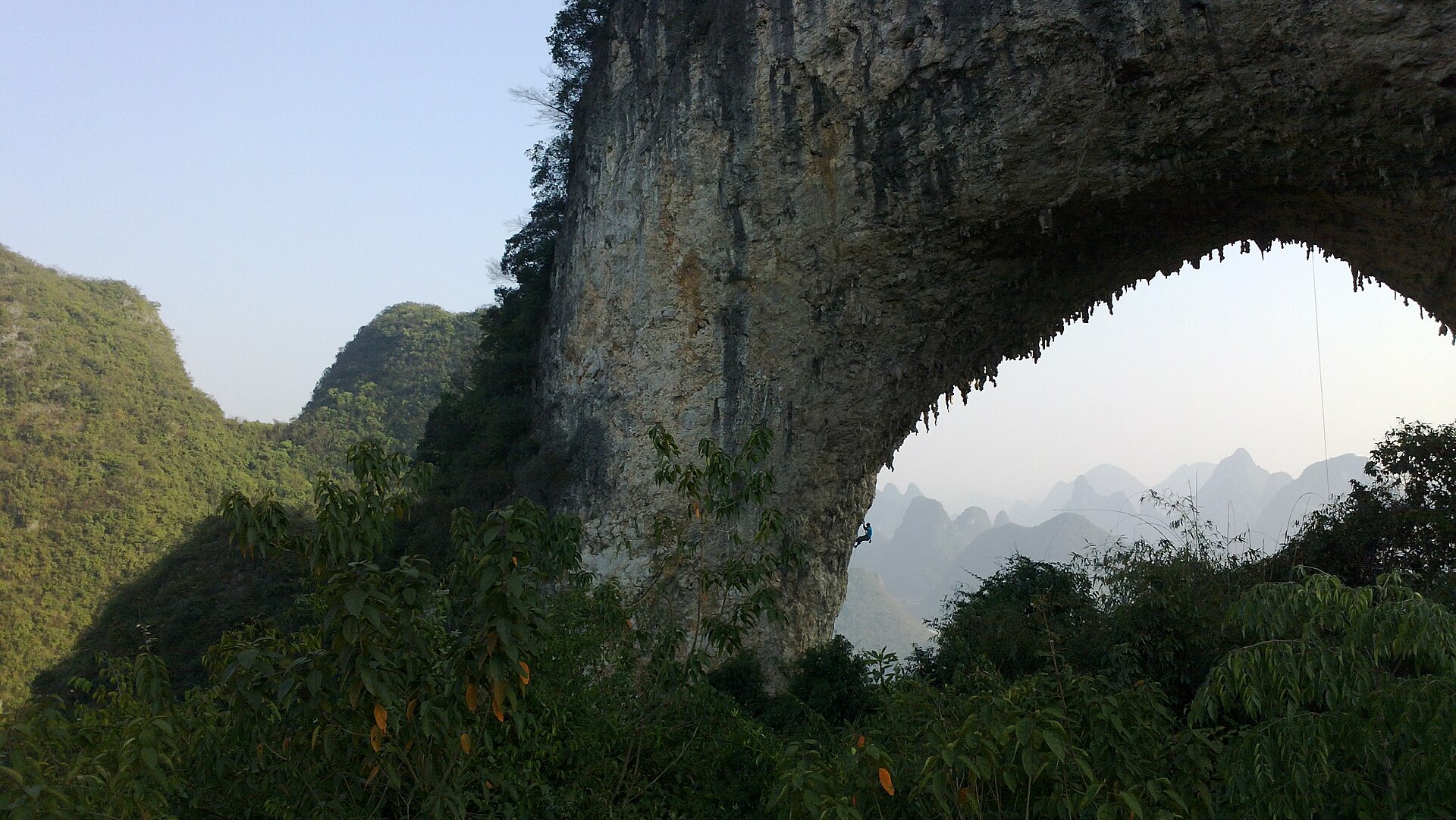
Ask where Chinese climbing lives and the answer rarely changes: Yangshuo, a county of rice paddies and river towns in Guangxi, where several hundred limestone towers stand close enough together that a strong cyclist can link the crags in a day. No other place in China has this combination of rock quantity, rock quality and rock proximity — and climbing towns are made of exactly those three things.
The rock that started it
The karst is Devonian limestone, deposited in shallow seas and then carved by water into towers, arches and overhanging walls that rise straight out of the fields. For climbers it offers everything: easy-angled verticals with big holds for learning, steep tufa columns for the strong, and multi-pitch adventures up formations that look unclimbable from the road. The most famous piece is Moon Hill, a natural arch with a road through it and a route up through the window itself.
The first climbers
Foreign climbers found the area in the eighties and nineties, when Yangshuo was still a backpacker stop on the Li River and the crags were reachable only by farm track. The bolted scene grew from there, decade by decade, until the town hosted international festivals and the farm tracks became sealed roads. The arc is a familiar one in climbing history — a place gets found, then gets equipped, then becomes a town with a climbing economy — but Yangshuo ran it at Chinese scale, which means fast.
The scene today
Today the county holds dozens of developed sectors, a resident community of local guides and establishers, and a steady traffic of visiting climbers from across China and beyond. Yangshuo also produced something rarer: Chinese climbers who learned on the karst and now establish routes elsewhere in the country. The town is where the national scene renews itself, every season, on the same limestone.
Visiting now
Practically, Yangshuo works better than almost any climbing destination in Asia: a high-speed rail station thirty minutes from the crags, hotels at every price, gear available in town, and a guide culture that runs from family top-rope mornings to hard project sessions. The climbing year is the cool half — October to April — with summer traded for early mornings and river afternoons. Our six-day climbing week runs the classic sectors with a local guide; the family break starts everyone on the big holds.
Where this leads
The Yangshuo climbing week
What the grades mean here
The karst seasons