
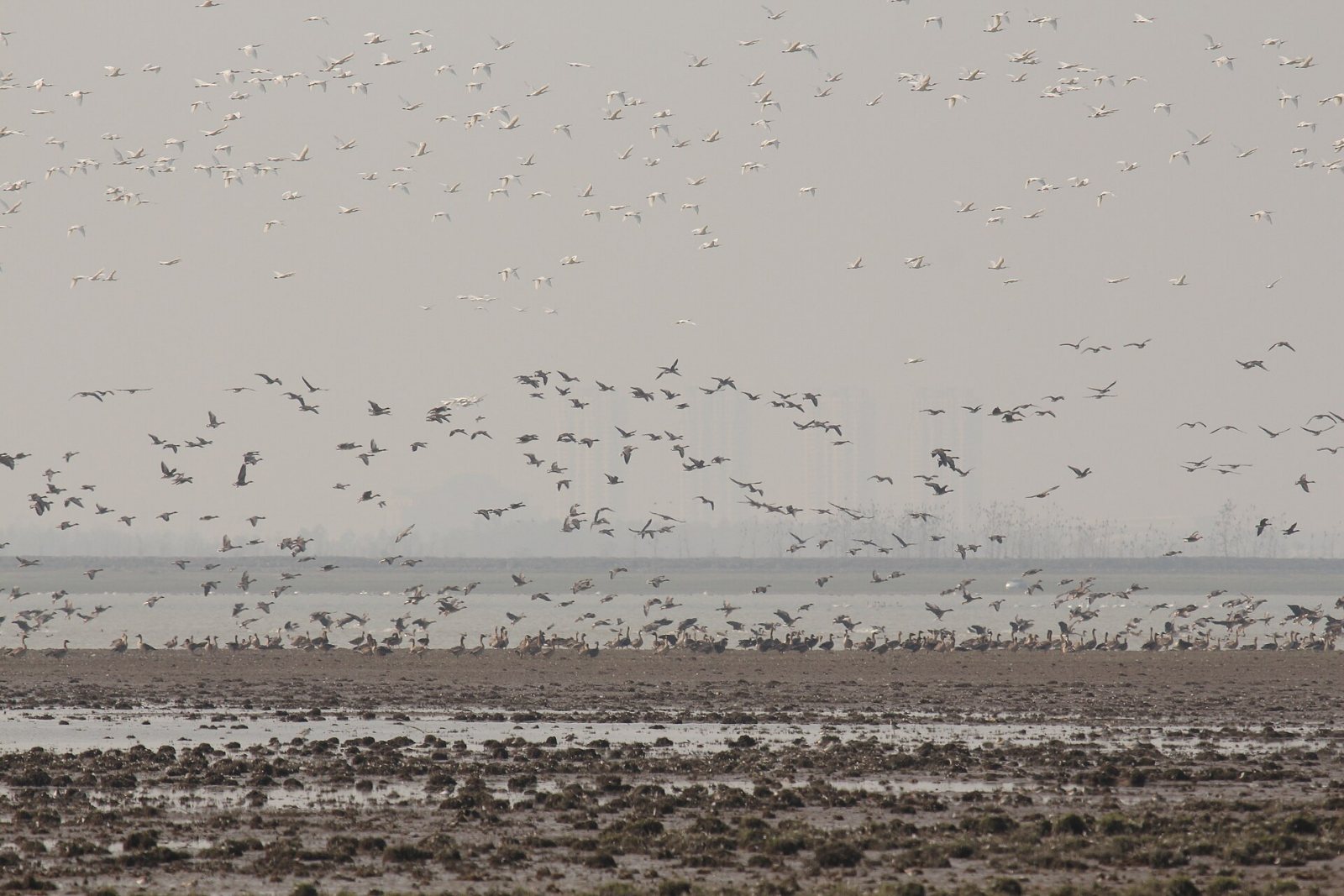
Most of China’s celebrated wildlife lives high — plateau, mountain, gorge. The country’s greatest bird numbers live at sea level, on a coast that most visitors never think to look at: the Yellow Sea mudflats of Jiangsu, where the tide runs out for kilometres and exposes a feeding ground of global importance. In 2019 these flats became China’s first coastal World Natural Heritage site, and in winter they host the largest wild wintering population of red-crowned cranes on earth.
The hinge of a flyway
The East Asian–Australasian flyway is the longest migration system on earth — Arctic Russia to Australia and New Zealand — and its birds funnel down the Chinese coast. The Yancheng mudflats are its fattest refuelling stop: a silt coast still growing seaward, loading migrating shorebirds with the fuel that carries them over open ocean. Tens of millions of birds pass through or winter here. When conservationists describe the site as irreplaceable, the arithmetic is literal: some species have nowhere else to do what they do here.
The spoon-billed sandpiper
The flyway’s emblem is a small wader with a spatula for a bill, down to a few hundred breeding pairs, that sifts the mud surface in a side-to-side sweep no other sandpiper copies. Spoon-billed sandpipers cannot complete their migration without the Yellow Sea mud, and Tiaozini — 270 square kilometres of flat at Yancheng’s southern end — is the place birders stand to find one: dawn, the tide pushing the flocks off the flats into the high-tide roosts, and a scope scanning ten thousand birds for one with a strange bill. Autumn and spring tides give the best odds; mid-winter shifts the emphasis to cranes.
The cranes inland
Behind the flats, the reed beds and farm fields of the Yancheng reserve hold the winter cranes: 542 red-crowned cranes counted in the 2025 survey, the largest wild wintering population anywhere, feeding in family parties at first light. The reserve’s rescued flock flies on display each afternoon — worth seeing for what close views teach, and always distinct from the wild birds at dawn. Add the coast’s third story and the trip completes itself: Dafeng, where the world’s largest wild herd of Père David’s deer — a species extinct in the wild by 1900, returned from European parks in 1986 — now numbers in the thousands.
Watching the tide country
The coast rewards planning more than fitness. The tide table sets each day; the roosts are watched from fixed points with a scope; the cold is wind-driven and the standing is real. Two hours by rail from Shanghai, it is the easiest great birding in China to schedule — and one of the few places where watching a single dawn tide rearranges your sense of how many birds the world still holds.
Where this leads
The Yancheng crane coast guide
The Yancheng crane coast tour
Two crane winters