
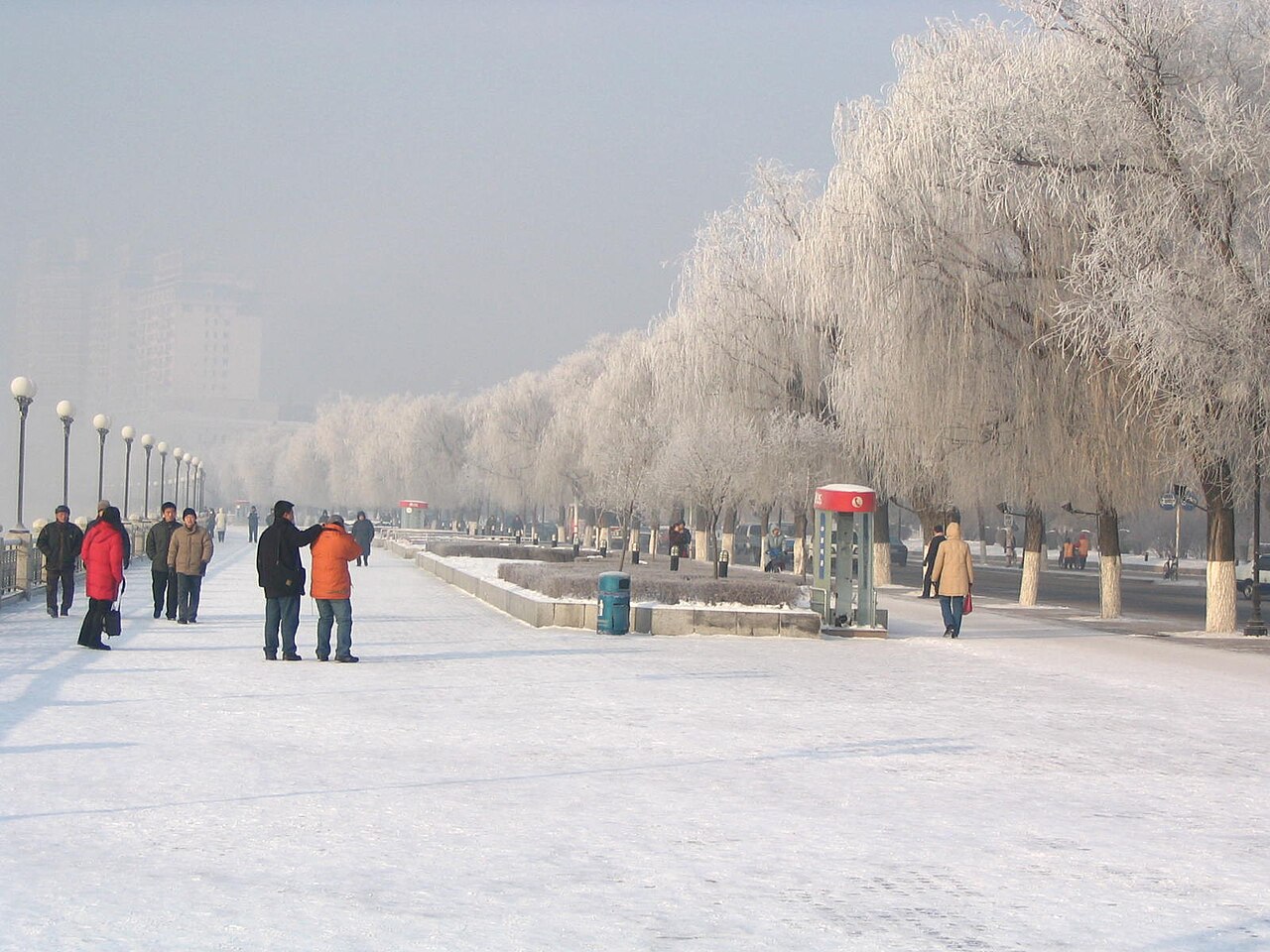
The ingredients.
Rime here begins with water that refuses to freeze. A hydropower station upstream releases water warmer than the winter air, so a stretch of the Songhua stays open while the banks are frozen hard. That open reach gives off vapour into air already well below freezing. On its own the vapour would simply drift away; the river supplies the moisture, but the valley supplies the rest of the conditions.
The second ingredient is stillness. The river sits in a sheltered reach where the wind drops overnight, and cold air pools along the water instead of being stirred. When that saturated, near-calm air touches branches already below freezing, the vapour deposits directly as ice crystals. It builds outward on each twig rather than settling as snow. Nothing about this requires a storm; it requires the opposite.
Overnight.
The formation is a night product. Temperature keeps falling after dark, the air stays quiet, and the vapour keeps arriving from the open water, so the deposits thicken hour by hour while nobody is watching. By first light the trees carry a white, granular coat, heaviest near the water and thinning inland. We arrive before the sun is up, because the display is already at its fullest.
Then the morning takes it apart. Sunlight warms the branches, the valley air begins to move, and the same crystals that held overnight loosen and shed. A breeze can clear a whole stand quickly; even on a calm day the rising temperature softens the structure. We do not treat this as a disappointment. The display is a physical state with a short life, and understanding that is most of what makes it worth getting up for.
Two mornings.
Because the mechanism depends on a precise combination of open water, low temperature, and calm air, we leave two mornings for it rather than one. Some dawns the wind is wrong, the air is too dry, or the plume drifts elsewhere, and the trees stay bare. Holding a second attempt is an honest reading of how many conditions must line up at once. We re-check the forecast before dates are fixed and keep the second morning free.
On the morning it works, we stay long enough to watch it go. The walk is short, the cold dry, and the change from white to bare happens without drama. What remains is the river, still open, ready to build the same thing the following night. We come back for the mechanism as much as the view, and the view is better understood for it.
Keep reading
Walking a frozen river
Hot springs
The snow calendar