
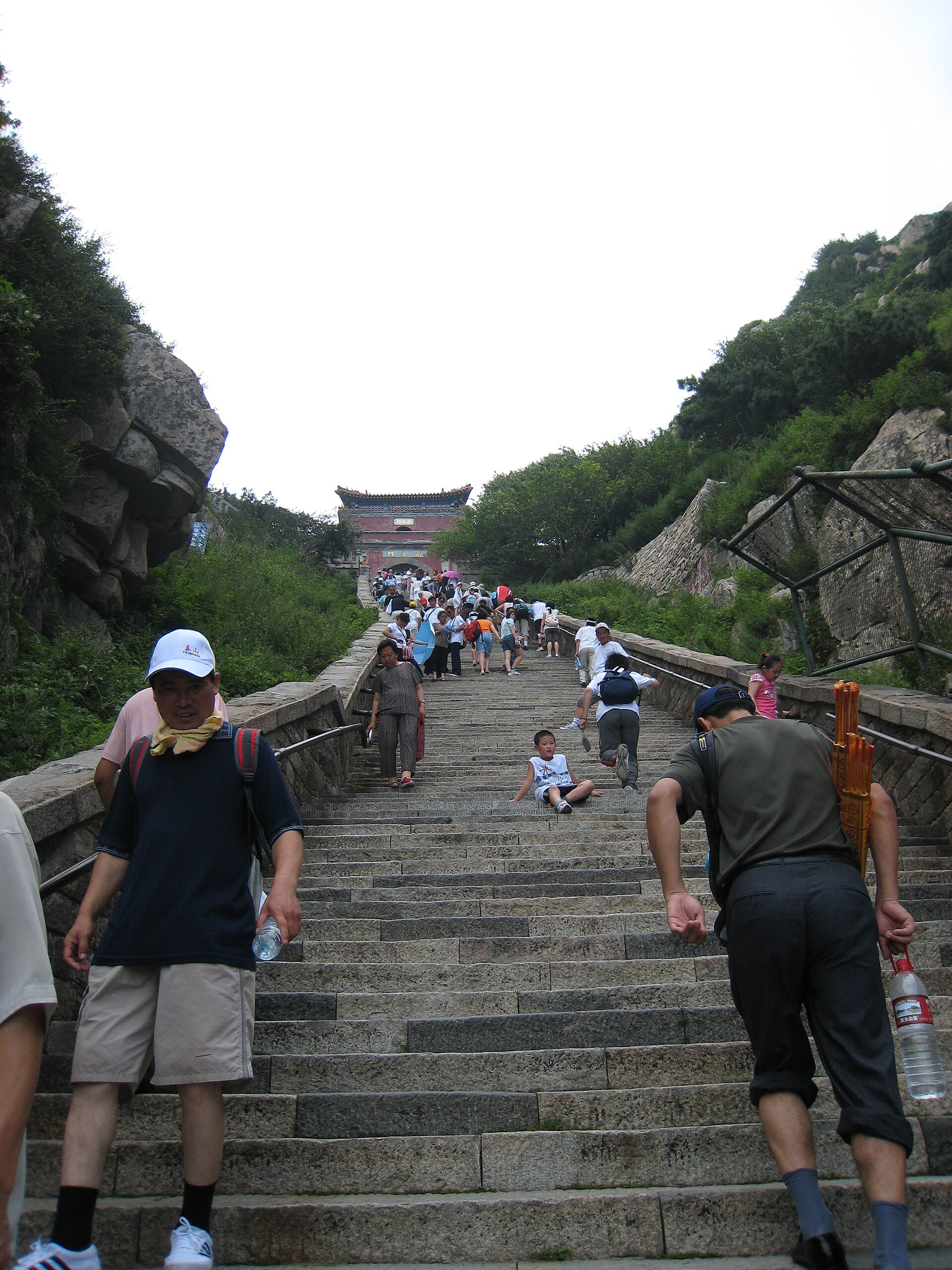
Night climbing in China is not a niche. It is the original way the mountains were climbed: pilgrims starting in the dark so they could meet the sunrise from the summit, emperors timing their ceremonies to first light, and entire villages walking lantern-lit trails to the temples above. The headlamp has replaced the lantern; the schedule has not changed.
The pilgrim tradition
The logic is simple and old: sunrise is the summit’s event, and the only way to own it is to climb in the dark. On the sacred mountains the night ascent became ritual — Taishan’s stairway has carried pilgrims through the small hours for two thousand years, and the teahouses that line it still never close.
Taishan, the night capital
Taishan remains the definitive night climb: roughly seven thousand stone steps, seven thousand lantern-lit teahouses below them, and a summit at 1,545 metres reached — by the classic schedule — at about five in the morning, in time for the sunrise platform. The full guide, with the cableway version and the descent through the back valley, is here.
The modern night climb
Beyond the sacred mountains, night walking has become the weekend climber’s trick: leave the city Friday evening, climb through the dark, camp or lodge on the summit, watch the sunrise, and be home by Sunday night. Wugongshan is the masterclass — a Friday-night headlamp ascent through cloud forest that pops out onto the meadow under stars, timed to a dawn sea of clouds from 1,918 metres. The weekend itinerary is built around exactly that rhythm.
How to do it well
The rules of the dark ascent are few and non-negotiable. Start earlier than feels necessary — night halves everyone’s pace and doubles everyone’s rest stops. Carry two light sources, not one. Wear one more layer than the valley says, because the temperature change is the climb’s real gradient. And know the descent plan before the ascent begins: tired legs on stone stairs in the dark is where night mountain culture collects its debts. Done properly, though, the night climb is the best deal in Chinese hiking — a full mountain, a sunrise, and a working Monday that never knew.
Where this leads
Night up Mount Tai
The Wugongshan weekend
Hua, the vertical mountain