
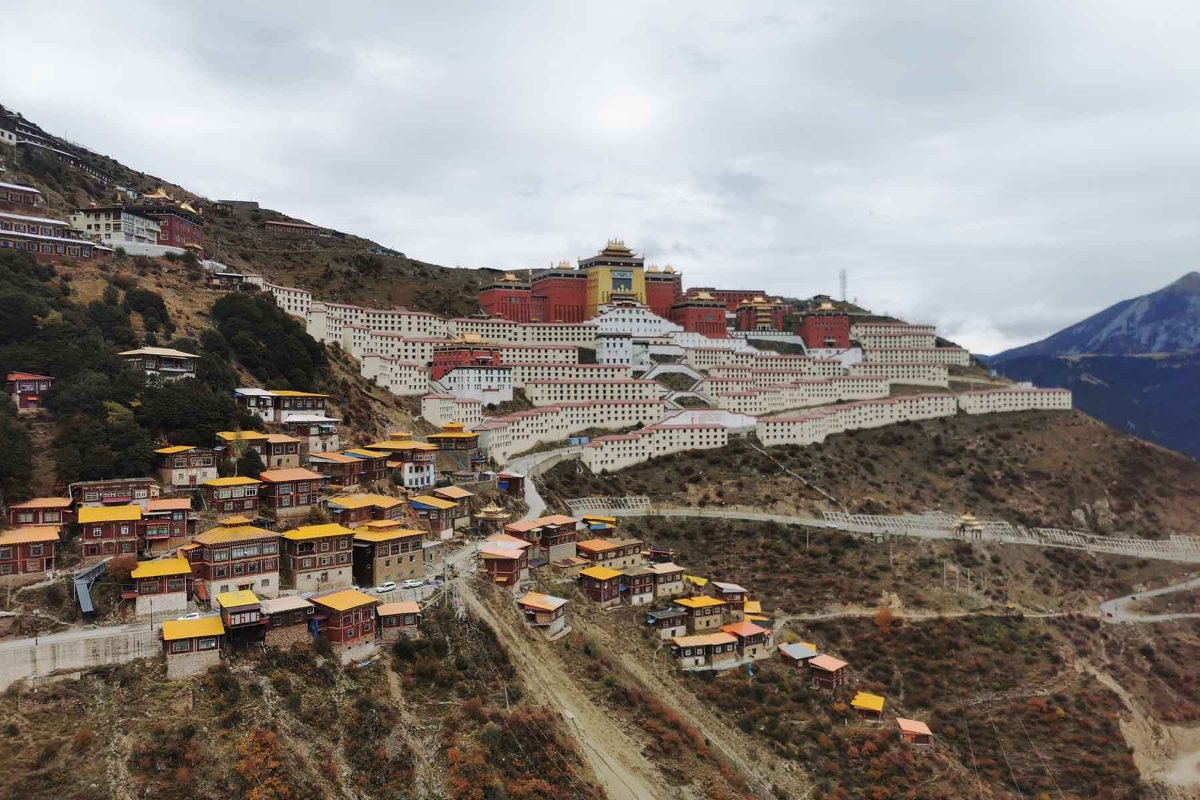
Every trekking region has its infrastructure. In Kham it was built centuries before trekking, and it is religious: the gompas, nunneries, mani walls and pilgrimage valleys sit exactly where the walking is good, because for a millennium the walking was the point. Our routes inherit that geography. This is a short field guide to the buildings you will meet, from the one you sleep in to the ones you plan a day around.
Gongga Gompa: the night under the mountain.
The most memorable lodging on any of our routes is a monastery. Gongga Gompa sits at 3,750 metres under Minya Konka’s south face, and the in-depth trek spends its second and third nights in the monastery dormitory — a bunk, shared washing, and a courtyard morning with the mountain over the roof. The 24-day journey returns there on days twenty and twenty-one after three weeks on the road. The group trek walks in from Langgatso on its day six, the lake that frames the mountain, and stands in the courtyard the same afternoon. Where else on a trek do you get woken by chanting instead of an alarm?
Tagong: nunnery, temple and the great mani wall.
Over the Zheduo pass, the grassland crossroads of Tagong carries a concentration of sacred architecture you can walk in a day: the monastery itself, the Anigongma nunnery, Muya temple, and the great mani wall — a wall of carved prayer stones long enough to be a landmark. The Yala trek finishes among exactly these: its last day runs out of the mountains and onto the grassland for “Muya temple · the mani wall”, and the 24-day journey gives Tagong a full day of monastery, nunnery and a fifteen-kilometre grassland walk between them.
The universities of the far country.
Only the long journey reaches Kham’s monastic heartland, and its temple day names the trio plainly: “Dzongsar with its school of medicine, Palpung with its painting tradition, and Katok, the Nyingma mother seat, on the way south to Baiyu.” These were universities in every sense that matters — medicine, art, philosophy — funded for centuries by the trade the tea-horse road carried through, and they are working institutions today. The remotest valley on the route, Dopu, sits in the same country; the day card calls the walk there the remotest of the journey for a reason.
Inside: the small etiquette.
The rules are few and easy. Walk clockwise around anything religious — temples, mani walls, the whole circuit of a monastery’s rooftops; locals will be, and you should be too. Shoulders and knees covered is the safe default, shoes off where the doorway says so, and ask before photographing inside any hall — courtyards and exteriors are generally fine, but the answer inside belongs to the monk you ask. Sit if invited, accept the tea if it comes, and do not point your feet at anything sacred. None of this is performance; it is just how the building works.
Why walkers notice them.
After a week on the trail the pattern clicks: the mani walls cluster at path junctions, the gompas face the passes, the prayer flags span exactly the gaps the wind uses. The builders walked the same valleys you are walking, for reasons more serious than yours, and placed their buildings where the walking was already good. The place-name page picks up the language half of this — every gompa and la you will meet is on it. And when the walking day ends in a courtyard instead of a tent — as the sleeping page describes — the history stops being scenery and becomes where you slept.
Monastery names, locations and route references checked 7 November 2026 against the route pages.
Walk between them?
The Gongga in-depth trek, two nights at the gompa
The 24-day journey, temple day included