
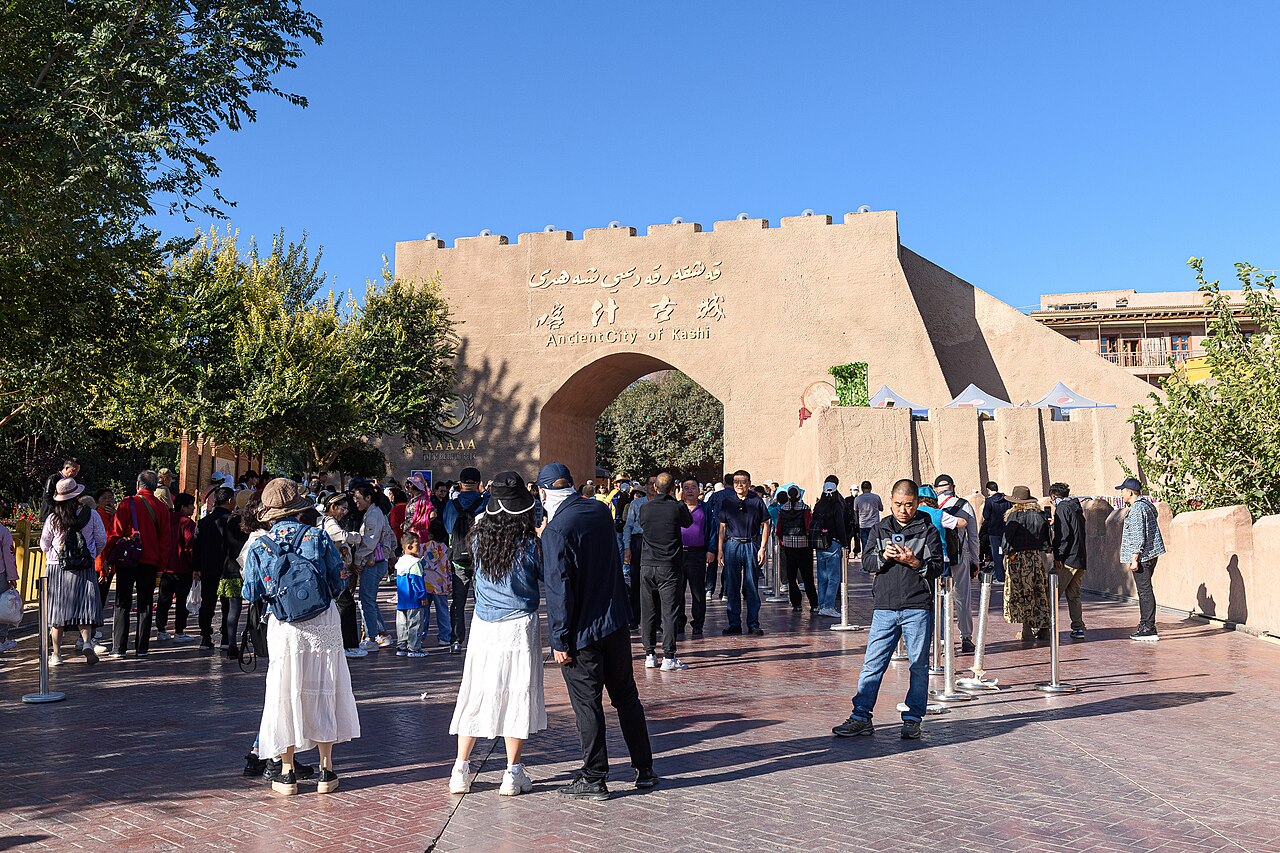
Kashgar's old city carries the most-debated conservation story on the plate, and visitors arrive expecting either a museum or a demolition. What they find instead is more interesting: a living town of some tens of thousands of people, part of it rebuilt stone-by-stone to a strict traditional vocabulary, part of it simply — continuing. The trick to the visit is knowing which streets are which.
The two cities inside the walls.
The rebuilt quarter sits near the east gate: new houses in old grammar — timber balconies, decorated door lintels, the brickwork details copied from the surviving originals — occupied by the families who lived here through the reconstruction. Three streets deeper, the fabric is genuinely old, unreconstructed, and at its most atmospheric precisely because it is ordinary: doorways opening onto courtyards, looms in back rooms, laundry lines over lanes too narrow for anything but people.
The gate quarter.
The east gate area is the postcard, and it deserves neither cynicism nor an apology. The reconstruction after the 2009 programme was contested — the engineering reason, seismic risk in rammed-earth housing, was real, and so was the loss of unrepaired fabric — and the result is the plate's most photogenic streetscape. Walk it early: the light comes down the main lane at an angle that makes the ceramics and the hanging carpets glow, and for the first hour the quarter belongs to the bakery and the cats.
The craft courtyards.
The workshops are the old city's real treasure, and they persist in both halves: coppersmiths hammering basins that have sold on this street for centuries, instrument makers, the woodcarvers whose window grilles dress every rebuilt facade. The courtyards welcome browsers, the prices are the prices, and the memento that makes sense here is functional — a bowl, a comb, a small table — rather than ornamental.
The hours that belong to residents.
The old city has a timetable of its own. Dawn to nine is the bakers'; the streets belong to schoolchildren around eight; the afternoon heat empties the lanes until the light softens, and the evening is the town's own — grandparents on doorsteps, children racing the alleys, the smell of the day's last bread. Our advice on every route is the same: come at dawn for the photographs, come back after dinner for the town.
How we walk it.
Our Pamir road journey opens with three days in the city, and the old city gets two walks: the dawn circuit of the gate quarter and the craft lanes, and an evening that ends at the teahouse with the day's musicians. Between them sits the Apak Hoja shrine, the Grand Mosque's square, and the market streets — but the lanes are the city. Guests who give them two mornings arrive at the plateau already understanding the place the road was built to reach.
Where this leads
The teahouse above the street
Guide: Kashgar
The Sunday livestock bazaar