
Jade went east from Hotan for something like four thousand years — the burial suits of Han princes, the seals of emperors, the courts of the Qing — all of it floated down out of the rivers of one oasis on the desert's southern rim. Long before silk gave the road its name, the jade road ran from here, and at Hotan the trade has never actually stopped.
The stone and the river.
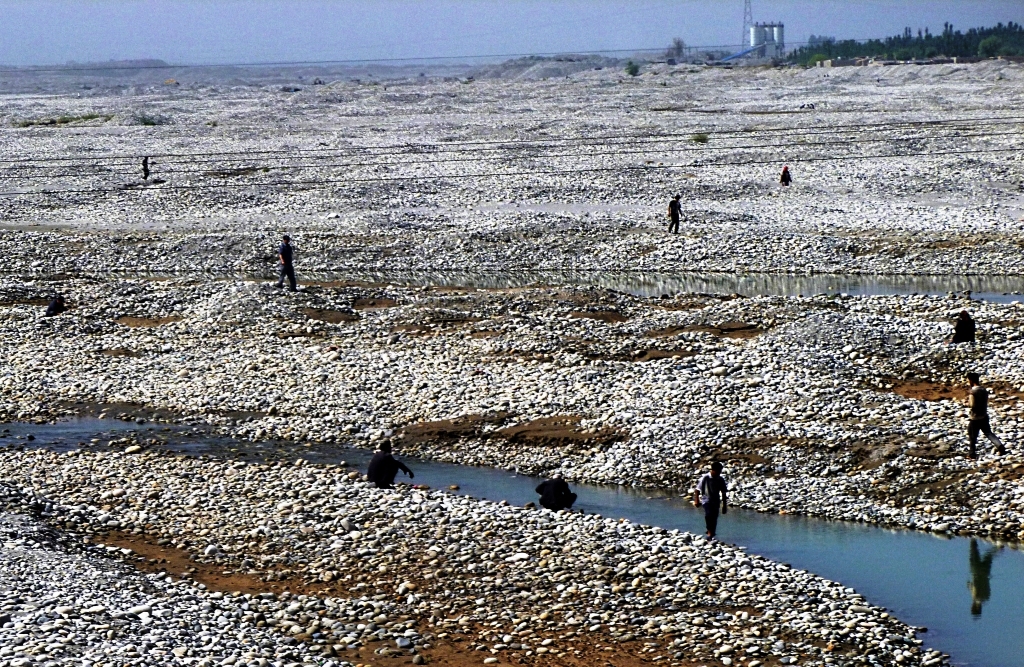
The jade of Hotan is nephrite, carried down from the Kunlun glaciers by two rivers — the Yurungkash, the White Jade River, and its black-stoned twin — and deposited in their gravel beds as rounded boulders. The finest grade is the mutton-fat white: a waxy, translucent stone that Chinese connoisseurship has ranked above every other material for three millennia. The rivers give it up in cobbles, which means the harvest is not mining but sifting: walking the gravel bars, reading the stones by eye and hand.
The diggings today.
The riverbanks below the city bridge are still worked, at a scale regulated down from the machine years. On any morning the gravel bars carry rows of people with rakes and sieves, and the boulders lifted out are cracked open on the spot to read the stone inside. Most of it is garden-grade; the finds that matter are rare enough that each one reorganises the digger's year. Watching is free, unvarnished and completely honest — this is a real extractive economy, not a show.
The market and its pantry.
The Sunday market is the great pantry of the southern rim, and it is a food market first: mountains of flatbread, melons stacked like artillery shells, dried fruit in colours that look invented, rows of cooked food where the whole oasis seems to eat lunch. The jade trading happens at the edges and in dedicated lanes — stones on tables, stones in bowls, and a taciturn economy of pocketed magnifiers. Buy nothing without help; the difference between a stone and a specimen is a skill, and the town respects the question.
Carpets and silk.
The oasis's second craft runs on looms. Hotan carpets — deep reds, bold medallions, wool famous for the local highland sheep — are woven in workshops where the knot-by-knot pace is visible, and the workshop visits on our routes are genuine: the weavers work while you watch. The same goes for the silk workshop at Jiya, where the cocoon-to-reel process runs as it has for centuries. The market's famous piece goods — Atlas silk in its electric ikat — come from here too.
A day in the oasis.
Hotan rewards a full, unhurried day: the river in the cool of the morning, the workshops before the lunch heat, the Sunday market (or its weekday successor) through the afternoon. Our Tarim loop arrives by the desert highway and holds the oasis for a night — which also buys the morning flight back east, over the basin we have just crossed on the ground. Guests leave with the same observation: the jade road was older than the silk road, and standing in the riverbed, you can feel why.
Where this leads
Guide: Hotan
Crossing the Taklamakan
The Tarim poplar autumn loop