
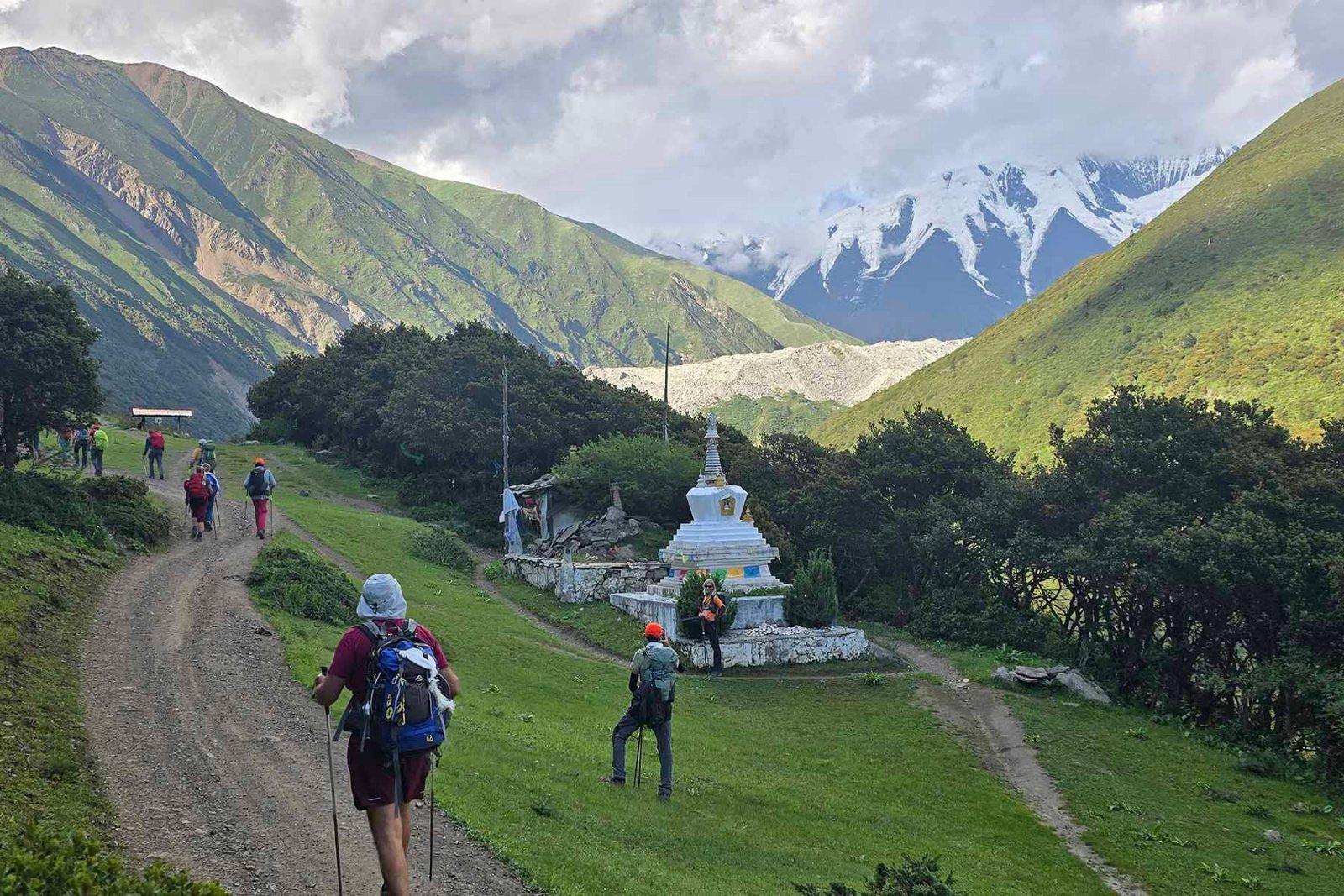
The Minya Konka range is usually reached the hard way: multi-day traverses with tents at 4,000-plus metres, carried or horse-hauled, weather-proofing every evening. That is a genuine and rewarding way in — we run several. But there is a second door into the same range, and it is slept differently: hotel, monastery, lodge. Not one night under canvas.
Why a no-camp trek is not a lesser one.
Five days, four nights: one hotel night in Xinduqiao at 3,400 metres, two nights of shared bunks at Gongga Gompa at 3,700 metres, and a lodge in the village country at 4,000 metres. Overnight luggage is carried between the night stops, so you walk with a day pack throughout. Dinners and breakfasts come with the night stops, cooked where there is a kitchen.
What this buys you is not comfort for its own sake. It buys the high days without the camp nights: the glacier valley and the holy lake are both still in, and your body spends its nights recovering instead of holding a tent down in the wind.
The night stops.
The drive west from Chengdu is six to seven hours on the expressway finished in 2018, and the first afternoon is spent the right way: a walk by the lake at the road pass near Mt. Yala, aiming to spend two or three unhurried hours at 4,000 metres before the night in Xinduqiao.
The second day drops over the Zimei Pass and walks about seven kilometres through rhododendron forest and prayer flags to Gongga Gompa — the Kagyupa monastery that has base-camped every expedition to the mountain since the 1930s. The walking day is short on purpose. The afternoon belongs to the temple and the view behind it, where sunset turns the 7,556-metre summit gold directly above the monastery roof. You sleep there twice, which is the point: one night to arrive, one to belong.
The closest approach to the mountain.
The middle day goes up the glacier stream behind the monastery, following the trail to the base camp used by climbers of 5,588-metre Mt. Nama at about 4,200 metres — the closest approach to Gongga Shan on this trek, with the glaciers of the range filling the head of the valley. Fourteen kilometres out and back on a rocky trail; it is the hardest day of the trip, poles earn their keep on the descent, and blue sheep are often on the crags above the path.
The lake that frames the range.
The fourth day retraces to the village, transfers to the base of the Langgatso walk, and climbs from 4,000 metres to the lake at 4,500 metres — the small holy lake that mirrors the whole west face of the range, main peak included, in one frame. It is the finest single view of the trip, and the whole afternoon is given to it. There is no rush, and horses can carry you up if the legs say no. The night is the lodge at 4,000 metres, and the fifth day is the long road east to Chengdu — about nine hours, arriving late afternoon.
Season, price, next step.
The join-in group runs on seven fixed dates from May to November 2027, two to eight trekkers, international only. The price is CNY 6,000 per person (CNY 5,600 booked sixty days ahead), the July and August departures run at CNY 6,400, and a private version runs on request — from USD 1,170 per person in a group of four.
If you would rather compare every way into the range — camping and non-camping alike — we have written them down side by side. And if the monastery night is the part that draws you, read the etiquette before you go: it is a temple first and a lodging second.
Sleep under the mountain?
The Minya Konka lodge trek, day by day
Five ways to walk Minya Konka, compared
The monasteries of Kham, and their etiquette
Where you sleep, from park hotels to a monastery floor