
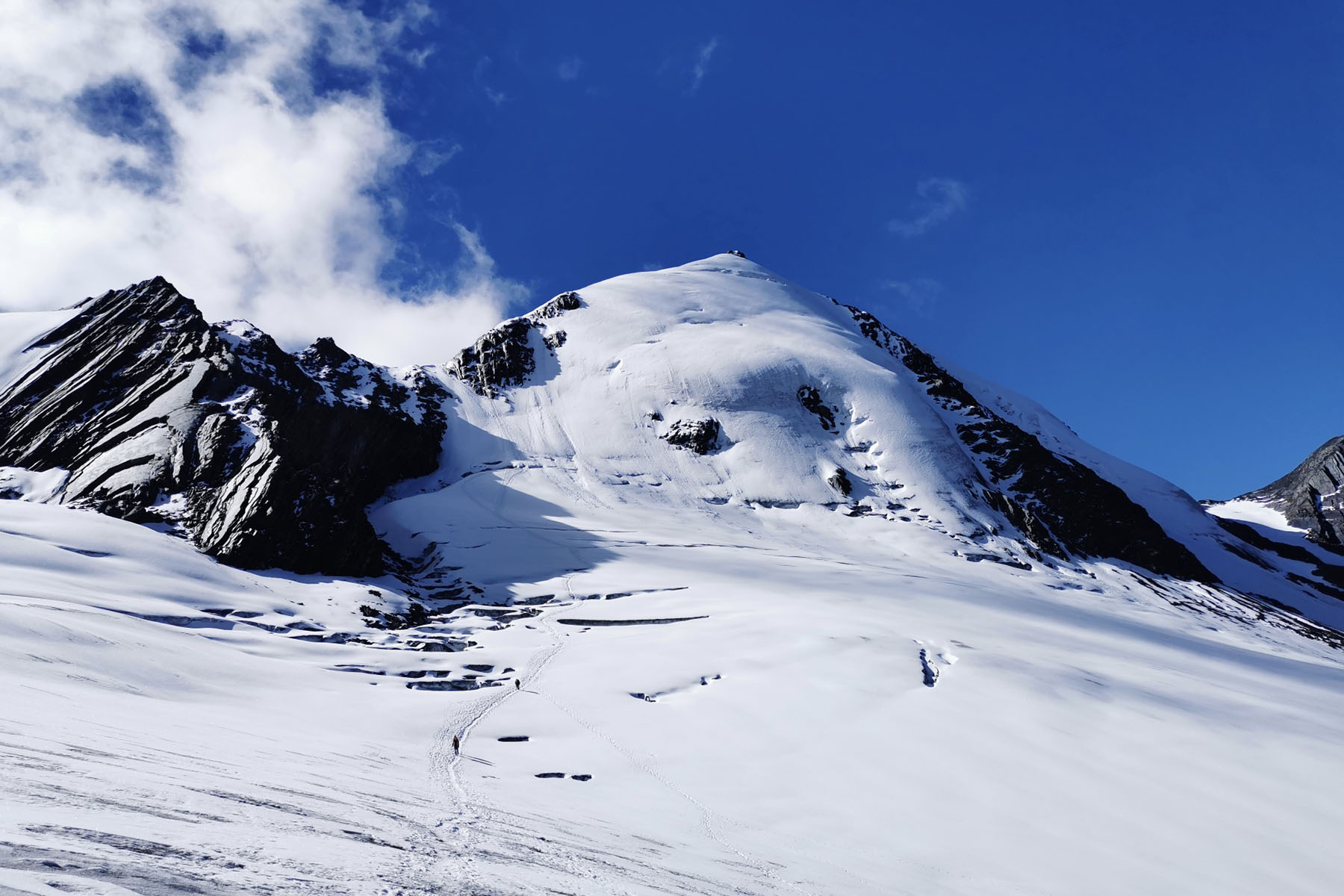
Every mountain on this site above the walking summits includes a school day — a few hours on snow and ice that convert a hill-walker into a rope-team member. The skills are simple to describe and strange to first perform. This is what the day holds.
The walk in them
Crampons change your feet. The first hour is unglamorous calibration: flat-footing on low-angle snow, duck-footing where the slope cuts back, keeping points out of your own trousers and your partner's rope. Guides watch new cramponists the way driving instructors watch new drivers — the first hour's habits are the ones that survive.
The self-arrest
Then the day's first real skill: stopping yourself. Sliding on your back, head uphill, axe across the chest, kick, roll, lever — and the mountain lurches to a stop under your own hands. Everyone does it badly twice and adequately by the fourth. The point is not elegance; it is the knowledge, banked somewhere below thought, that a slip on this slope has an answer.
Front-pointing
Where the slope steepens, the technique changes: two front points into the ice, body weight over the feet, axe planted high and pulled on like a ladder rung. It looks athletic from below and feels mechanical from on the rope — ten front-pointed metres teach more confidence than a season of reading about them.
The rope team
The day ends with the skill that matters most: moving as a roped team — spacing, calls, the choreography of arrest as a group, the fixed-line system some routes use. The school day's real product is not technique but trust: by afternoon the rope is not a leash, it is a conversation. That conversation is what summit day runs on.
Where this leads
The ice climbing hub
The ice season
The mountain progression