
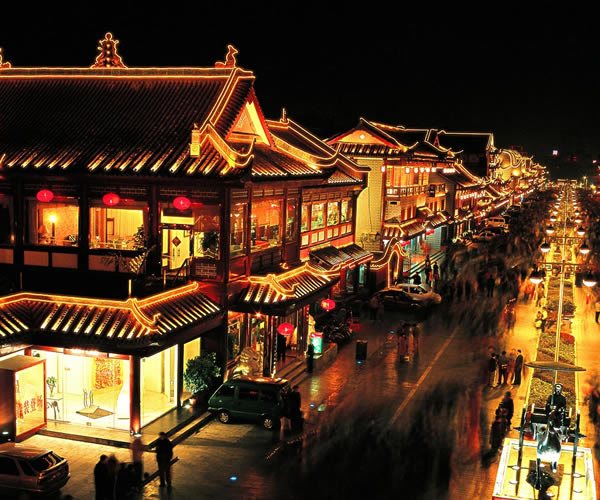
The night market is not a modern street-food trend — it is a Song dynasty invention. When Kaifeng, then the world’s largest city, lifted the old curfew, a night economy appeared that had never existed anywhere at that scale: diners out after dark, stalls lit by lamps, a whole mealtime invented between sunset and sleep. The dynasty’s food writing reads like today’s market reviews.
The Song invention
Kaifeng still runs the argument — its Drum Tower market works the same hours under the same idea. What the Song started, every dynasty kept: the night market is where regional street food lives when the restaurants close, and where a city’s late-night identity is decided.
The cities that run them best
Xi’an’s Muslim Quarter turns the idea into a nightly festival of skewers, breads and sweets, dense enough that our Xi’an food weekend gives it a whole evening. Chengdu runs the refined end — night food streets where the snacking goes past midnight, the province of Chengdu after dark. Changsha’s markets ride a late-night crayfish economy; Lanzhou’s night lanes pair the noodle city with grilled lamb; Kaifeng’s original still trades under its drum tower, soup and all.
How to eat one
Three rules. Walk the whole row once before buying anything — the first stall is rarely the best. Order small and often, one dish per stop, sharing everything. And finish sweet: every regional market has a dessert stall worth the queue, from candied fruit to hot rice cakes. Do that and the night market feeds you better than most restaurants — which is, after a thousand years, exactly what it was invented to do. For the morning after, see the Chinese breakfast map.
Where this leads
The Xi’an food weekend
Chengdu after dark
The Chinese breakfast map