
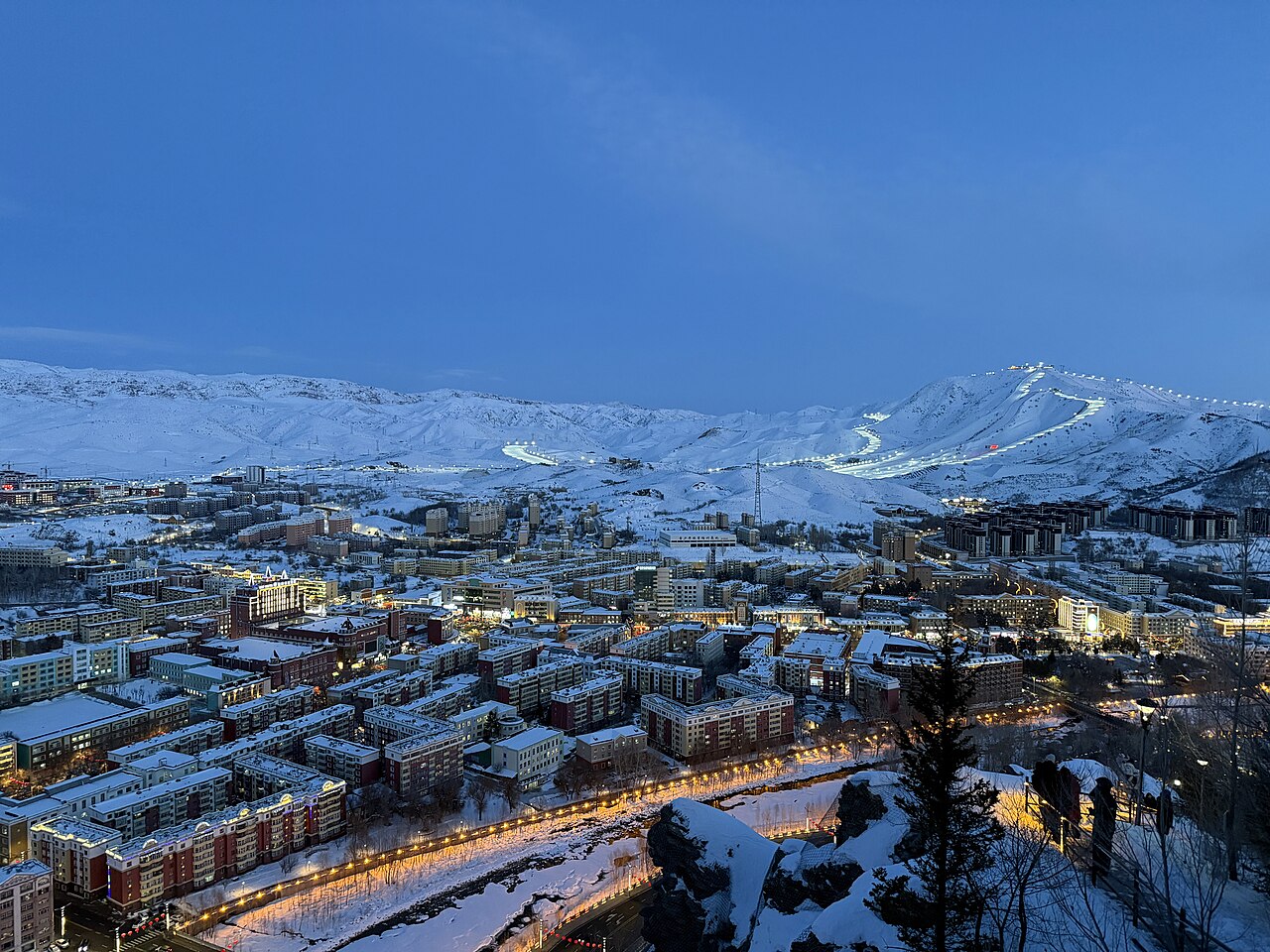
The hill in town.
Jiangjunshan belongs to the city rather than a remote valley. We reach it from an ordinary street, and at 460 m of vertical the runs are short and repeatable, not committing. We treat it as a place to stack laps. The slopes hold a settled base through the cold months, and a skier can go from a room to a lift without a transfer. That proximity is the point.
Altay sits far inland and the winter air is dry, so the snow keeps its texture through an afternoon instead of turning heavy. We call that surface honest: it does not hide ice under a wet top layer. After a long rail or road journey, the city hill is a low-stakes first session. Boots get tested here, and short runs let people find their legs before a bigger mountain further out.
Under the floodlights.
The floodlights come on as the light drops, and the change is practical before it is atmospheric. A lit piste is a narrower world: the edges stay crisp, the unlit ground beyond the poles disappears, and the eye reads the groomed corduroy instead of the hillside. We find people ski more slowly at night, because a pool of lamp light sets a clear boundary. Fallen snow reads flatter under it, with less contrast.
Temperature is the other change. Once the sun is gone the air settles toward the cold end of its range, and the surface firms again after any afternoon softening. We plan layers for this: the jacket that felt excessive at midday earns its place after dark, and hands and faces need covering the afternoon did not demand. It is a colder, quieter outing, and we pack for it on its own terms.
The shape of the evening.
Night skiing reorganises the day. We stop treating the last lift as the end and start treating the afternoon as a pause: a rest, a meal, a change of base layer, then back out under the lamps. For mixed groups this helps, because a late session lets slower skiers put in time without the pressure of a first-hour start. It spreads demand across the day instead of stacking everyone at opening.
We keep the details provisional. Lit hours, which runs are open, and whether the evening session runs at all are subject to weather and resort confirmation, and we re-check before dates are fixed. What we plan around is the rhythm: a city hill with floodlights turns one ski day into two shorter, more deliberate ones. We would rather describe that than promise a schedule the mountain has not agreed to.
Keep reading
Why the snow stays dry
Reading the vertical
Late season in the Altai