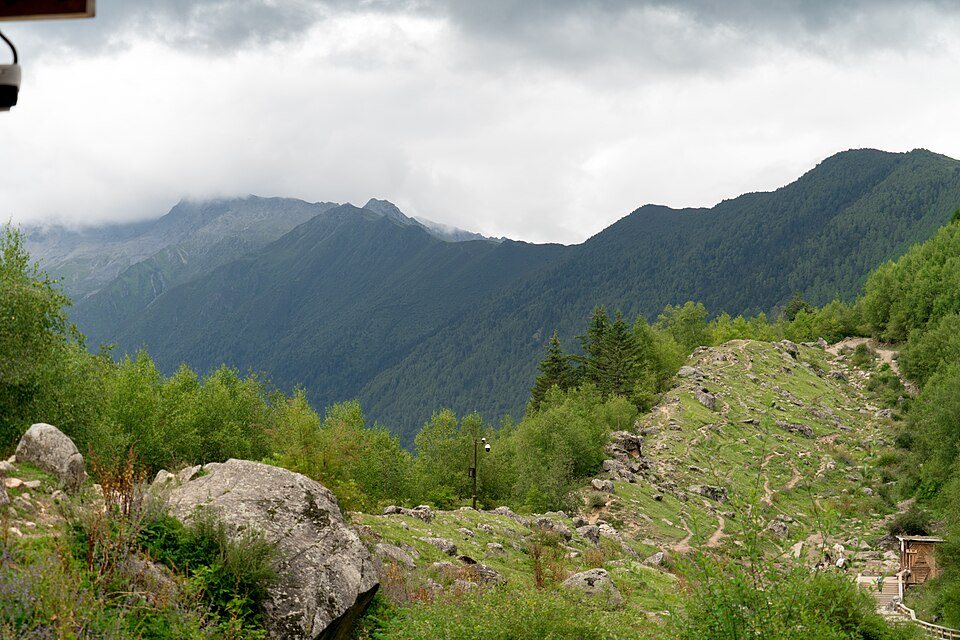
Low cloud sitting on a forested ridge above a valley floor in the Siguniang reserve

Destinations / Sichuan / Guides

The year at 3,200 metres.

An annual mean of 6.1 degrees, a wet season that starts in May and a dry winter with clear skies and brutal mornings. The mountain makes its own weather, and the difference between the town and the valley heads is bigger than the difference between the seasons.

Explore the guide ↓

Siguniang · weather

Annual mean
6.1 °C
July mean
13.5 °C
January mean
−2.5 °C
Annual rain
931 mm

A wet summer, a dry winter, and two short windows in between.

The figures below are the published normals for Siguniang town: a mean of 6.1 degrees, July at 13.5 and January at −2.5, with 931 mm of precipitation and 78 frost-free days a year. Those numbers describe the street you sleep on, not the valleys you walk into.

The pattern that matters is the split between the dry season, November to April, and the wet one, May to October. Winter is cold, clear and windy; summer is green, wet and cloudy; the two best windows are the three weeks before the rains and the four weeks after them.

The year, month by month.

What to expect, and what the valley is doing.

MonthTownConditionsVerdict
January−2.5 °C meanDry, clear, very cold mornings; ice in ShuangqiaoBest for ice, hardest for comfort
February−1 °CSettled, windy, snow on the valley floorsGood, quiet
March2 °CThaw, dust, strong afternoon windMixed
April5 °CWarm days, snow still on the passes, dryVery good
May9 °CGreen up, first rains, rhododendronGood, then wet
June12 °CWettest month, cloud on the peaks most daysPoor for views
July13.5 °CWarm, wet, flowers at their bestGood for meadows, bad for summits
August13 °CRain, some clear morningsUnreliable
September10 °CRains ease, air clears late in the monthImproving fast
October6 °CClear, dry, larch turning goldThe best month
November1 °CCold, clear, first snow on the floorsExcellent, and empty
December−1.5 °CDeep winter, ice season opensFor climbers and empty-valley people

January and July are the published means for the town; the months between are interpolated from them and should be read as a pattern, not as station data. Add 5 to 8 degrees for a sunny afternoon and subtract 10 for a clear night: the diurnal range here is larger than the seasonal one.

How much colder the valleys are.

Six-tenths of a degree per hundred metres, and it adds up fast.

The arithmetic

Temperature falls about 0.6 degrees for every 100 metres of height. From the town at 3,160 to the top of Shuangqiao at 3,840 is 680 metres, or roughly four degrees. To the Haizi lakes at 3,800 is about the same. To a 4,300-metre base camp it is seven degrees.

What it means

A pleasant 15-degree afternoon in town is an 11-degree afternoon at the larch forest and a 7-degree one on the Haizi meadow once the sun goes. People dress for the town and get caught at the top.

Wind

The valleys funnel wind in the afternoon, which removes another two or three degrees of perceived temperature. A shell is not optional above 3,600 in any month.

The four seasons, honestly.

None of them is bad. Two of them are better.

Winter, December to February

Cold and clear. The peaks are at their sharpest, the valleys are empty, and Shuangqiao stays open for the ice. Nights of −15 are normal in January, and the town is quiet enough that half the restaurants close.

Spring, March to May

Windy and dusty in March, then suddenly green in May with rhododendron on the lower slopes. The first rains arrive at the end of May and the peaks start hiding.

Summer, June to August

Warm, wet, and the only season when the meadows are worth the walk for their own sake. Cloud sits on the summits most afternoons. If you came for the mountain, this is the wrong season.

Autumn, September to November

The window. Rain stops, air clears, larch turns in the second half of October and the first snow whitens the valley floors in early November. Also the busiest three weeks of the year.

Cloud, and why mornings matter.

The mountain makes its own weather by mid-morning.

The daily cycle

Clear at dawn, convective cloud building on the ridges from about ten, summit obscured by two, clearing again after sunset. This is why every itinerary here starts before eight and why the last bus down is more useful than the first bus up.

The forecasts

Town forecasts are for the town. They tell you nothing about whether Yaomei is out. The park’s own WeChat account posts valley conditions in the morning, and the guesthouse keeper will know.

The good sign

A hard frost and no wind at dawn means a clear day. Cloud sitting on the ridge at dawn usually means it will be on the ridge all day.

What to pack for these numbers.

Layers, and one genuinely warm one.

Three layers

Base layer, fleece, and a windproof shell with a hood. The shell matters more than the fleece, because wind is what actually makes it cold here.

Feet

Boots with a real sole for the dirt sections, and something dry to change into at the end of the day. The boardwalks are slippery in rain and lethal in ice.

Sun

At 3,200 metres the ultraviolet is roughly a third stronger than at sea level, and snow doubles it. Sunglasses are not a style choice on a glacier basin.

What to check on the morning.

Two sources, five minutes.

The park

The official account posts opening status, road conditions and any closure in the valleys before eight. In winter this is the difference between a day out and a day in the guesthouse.

The road

The Balang tunnel is usually open; the old pass usually is not. If you are driving yourself, check the tunnel status before you leave Chengdu rather than at Yingxiu.

Tell us which valley you are here for.

We build the days around the valley you actually want to walk, not the one that fits a coach timetable.

Start my journey brief ↗