Language
A Tibetan dialect usually called Jiarong, with no traditional written form in everyday use; scripture and liturgy are in classical Tibetan.
 Start your enquiry
Destinations / Sichuan / Guides
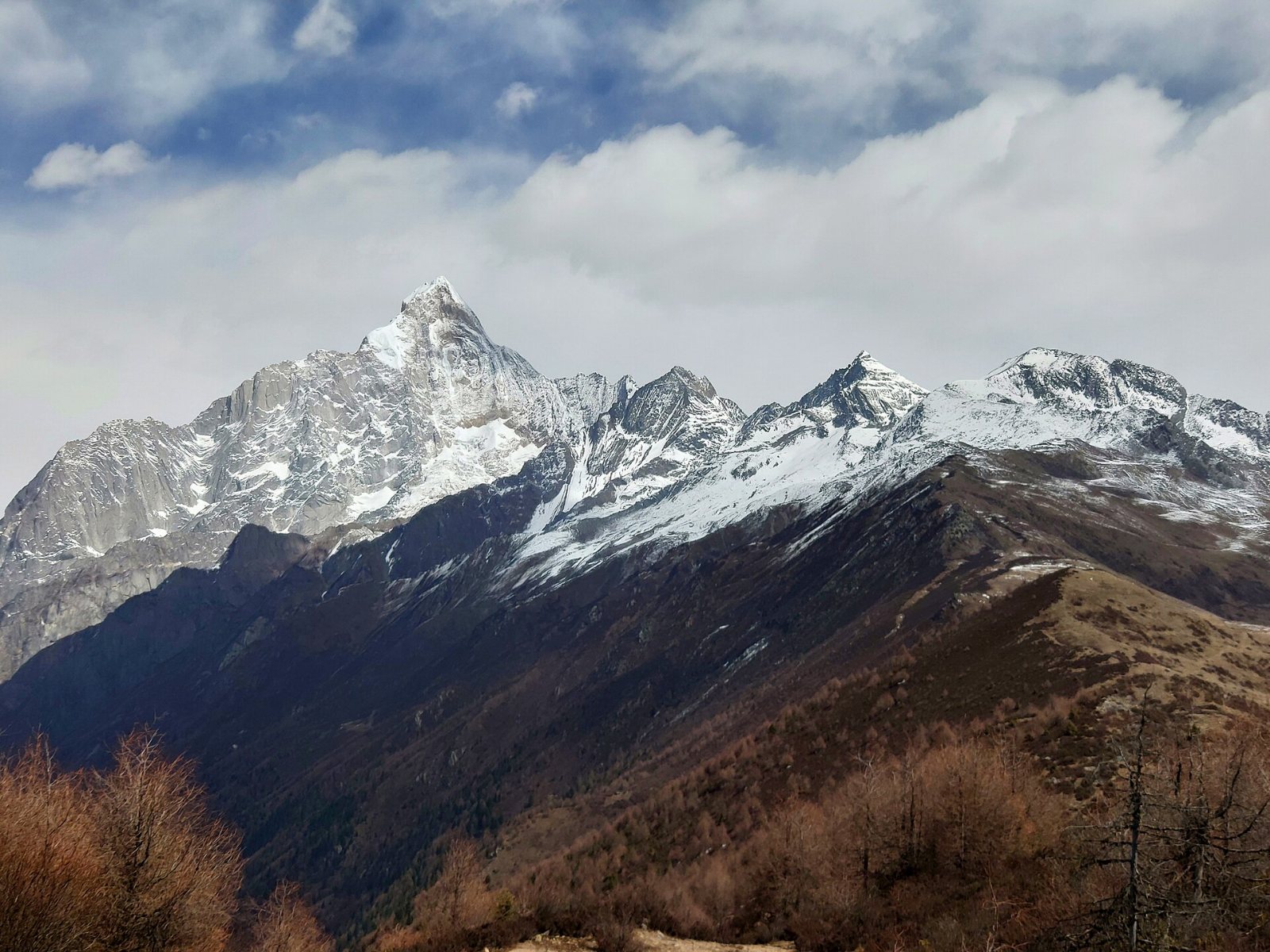
The four peaks are four sisters, the youngest and tallest is the one everybody photographs, and once a year the whole valley climbs to a meadow at 3,670 metres to feed them. This is Jiarong country, not Tibetan plateau, and the difference shows.
Explore the guide ↓Siguniang · the people
The Jiarong are Tibetan-speaking farmers of the eastern ranges — Xiaojin, Jinchuan, Maerkang, Li county — and the old Tibetan word for them is rongba, the people of the warm valleys. They grow barley and apples, keep yak in summer pasture, and dance a circle dance called zhuo that has its own repertoire for every occasion.
Siguniang is their mountain. The Tibetan name used locally is Sigula, and the monastery in Changping valley carries it. The four peaks are not just scenery here; they are relatives.
Not the same as the nomads on the plateau, and they will tell you so.
A Tibetan dialect usually called Jiarong, with no traditional written form in everyday use; scripture and liturgy are in classical Tibetan.
Farming rather than herding: barley, potatoes, apples, and yak moved up to summer pasture by part of the family. The valley floors here are fields, not grassland.
Stone and rammed earth, three storeys, with the animals below and the shrine on the roof. The white-and-red painted version you see in the town is a recent tourism idiom; the villages up the side valleys are the real thing.
A flood, a fight, and four girls who did not come back.
Four sisters fought an ogre that was flooding the valley and, when it was done, turned into the four peaks: Dafeng 5,025, Erfeng 5,276, Sanfeng 5,355 and Yaomei 6,250. The youngest is the tallest because she stood at the front.
Every guide tells it slightly differently, and the version with a hunter and a magic mirror is also current. Treat it as a family story rather than a canon.
The sisters are said to have turned to stone on the fourth day of the fifth lunar month, which is why the festival is on that day.
Three days at 3,670 metres, and a lot of smoke.
Guozhuang meadow, also called Chaoshang meadow, at 3,670 metres above the town, on the fourth to sixth days of the fifth lunar month — usually late May or June, moving with the lunar calendar.
A monk-led purification and a burnt offering: bundles of juniper and effigies of horses and figures carried round the meadow and set alight, with paper wind-horses thrown into the air. Then horse racing, wrestling, tug-of-war, and hours of circle dancing in full dress.
A petition for good weather and a good harvest, addressed to the four peaks by the villages that farm below them. It is a working ritual with a party attached, not a performance.
Five practical points.
The meadow is a forty-minute climb from the Haizi gate and the gate opens at eight. The ritual starts in the morning; by noon it is a party.
People are in their best clothes and most are happy to be photographed, but ask first, and do not stand in front of the dancers to get the shot.
The burning and the circumambulation are the ritual. Stand at the edge, out of the smoke, and do not cross the line of the procession.
This is the one day the meadow fills. Transport up the valley is on foot or by horse, and the park runs to its daily cap.
Anything sold to you as a ritual privilege at the edge of the meadow is not part of it.
Where the culture is, when there is no festival.
Sigula monastery at 3,250 metres in Changping valley is small, active and used to visitors. Morning is the time to go, and the walk there is on the shuttle road.
Shuangdiao and the side valleys off the main road have the older houses. A guesthouse in one of them is a different trip from a hotel on the street.
Yak, barley, apples, and a fermented barley drink served warm in a single cup that is refilled without asking. Accept it once.
We build the days around the valley you actually want to walk, not the one that fits a coach timetable.
Start my journey brief ↗