Guesthouses
Family-run, four to ten rooms, Tibetan or Jiarong decoration, and a shared kettle. Cheap, warm enough in summer, and often without central heating in winter. Ask specifically whether the room has a heater and whether it runs all night.
 Start your enquiry
Destinations / Sichuan / Guides
There is one town, one street and one altitude: 3,200 metres. The choice is not really where to sleep but which end of the street, and whether the room has oxygen and heat. Both matter more than the view.
Explore the guide ↓Siguniang · beds
Siguniang town — Rilong on every map printed before 2013 — runs along the valley floor at 3,160 metres, with the Changping and Haizi gates at the eastern end and the bus station at the western. Everything in between is guesthouses, restaurants, a clinic, and shops selling gloves.
Because the whole town is at the same height, the usual advice about sleeping low does not apply here: you are at 3,200 whichever bed you choose. What does apply is warmth, oxygen and how far you are from the gate you need at eight in the morning.
Three clusters, three different mornings.
| Cluster | Best for | Walk to the gate | Trade-off |
|---|---|---|---|
| Changping gate end | Changping and Haizi, both at 08:00 | 5 minutes | Quiet at night, thin on restaurants |
| The middle | Everything, and dinner | 10–15 minutes | The busiest and noisiest part |
| Bus station end | Early coaches out, Shuangqiao | 5 minutes to the station, 20 to Shuangqiao by car | Furthest from the two walking valleys |
The town is 1.5 km end to end, so “far” here means a fifteen-minute walk at altitude, which is not nothing on the first night.
Three grades, and the difference is the heating.
Family-run, four to ten rooms, Tibetan or Jiarong decoration, and a shared kettle. Cheap, warm enough in summer, and often without central heating in winter. Ask specifically whether the room has a heater and whether it runs all night.
The bulk of the town: concrete building, lift, electric blankets, breakfast of noodles and eggs. Reliable, unromantic, and the right choice if you are climbing the next day.
A handful of hotels pipe supplementary oxygen into the room, and it is the single most useful upgrade on a first visit. It does not fix altitude, but it turns a bad night into a survivable one. Ask for “mi man gong yang” — diffuse oxygen supply.
Between December and February the question is heat, not view.
Many buildings are heated by split units that are switched off when the room is empty. Arrive to a cold room and it takes three hours to warm at 3,200 metres. Confirm that the heating goes on before you arrive.
Pipes freeze. Ask whether the hot water runs in the morning, and expect the answer to be honest rather than reassuring.
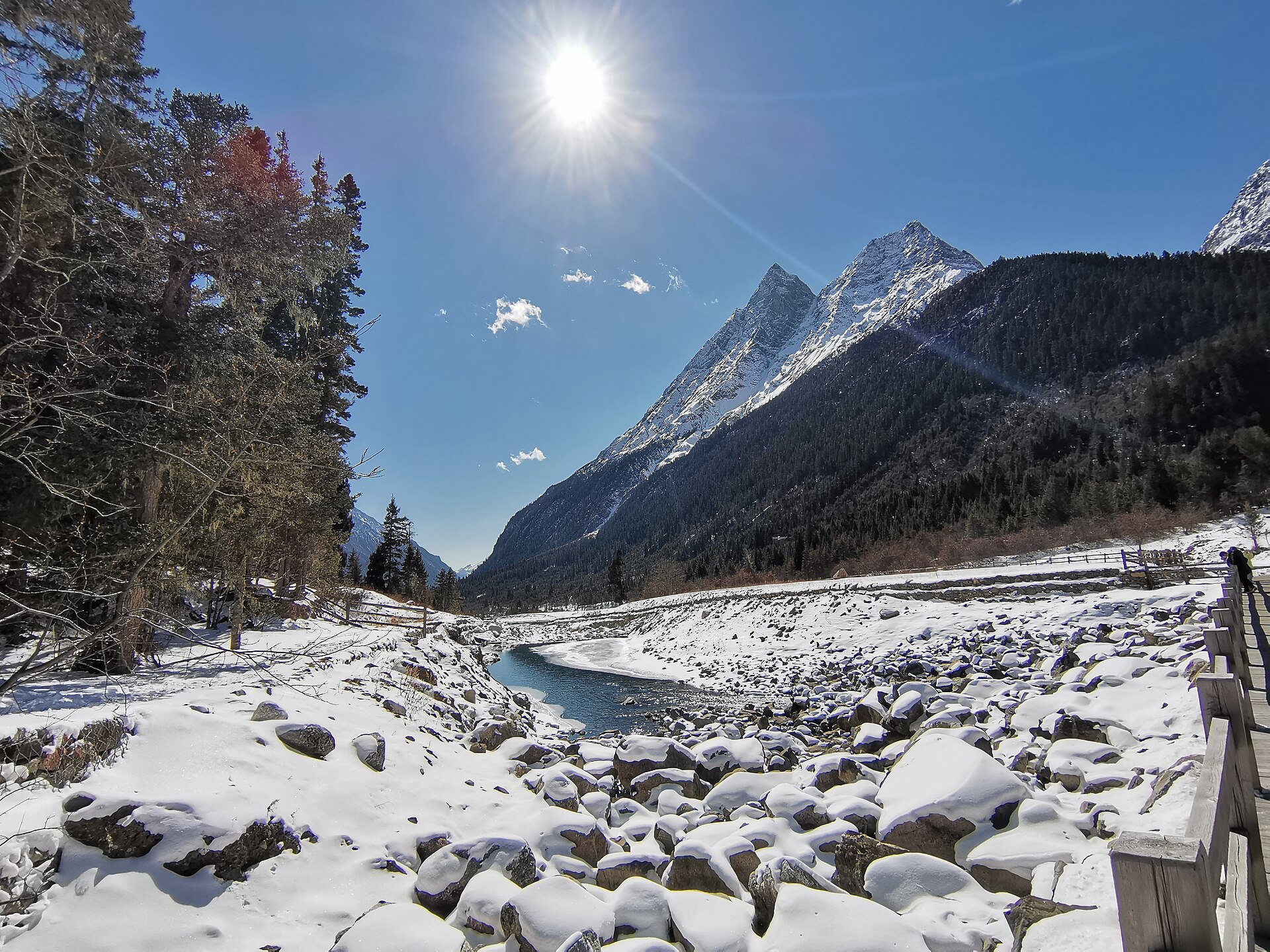
Empty valleys, ice on the walls, and the four peaks at their most defined. Winter is the best season here for anyone who does not mind a cold room.
Yak, potatoes, and one good noodle shop per cluster.
Yak hotpot, yak yoghurt, potatoes in every form, and handmade noodles. The local apples in autumn are excellent and sold from crates on the pavement.
Kitchens close early, by nine in the low season. If you come down from Changping at seven, eat first and shower second.
Loss of appetite is a symptom, not a preference. If you cannot face dinner on the first night, drink the soup and go to bed early; that is the correct response, not a failure.
One rule, and it is not negotiable.
Do not go up to a camp or a valley lodge on the day you arrive from Chengdu. The town at 3,200 is already 2,700 metres above the city; that is enough for one day.
If you are climbing, the night before the summit is at 4,300 or higher and you will not sleep well. Plan the summit for the second morning, not the first.
There is a small hospital in the town with oxygen and a hyperbaric chamber is available in Xiaojin, 50 km away. Our altitude page sets out what to watch for.
We build the days around the valley you actually want to walk, not the one that fits a coach timetable.
Start my journey brief ↗