Five Flower Lake & the lake chain
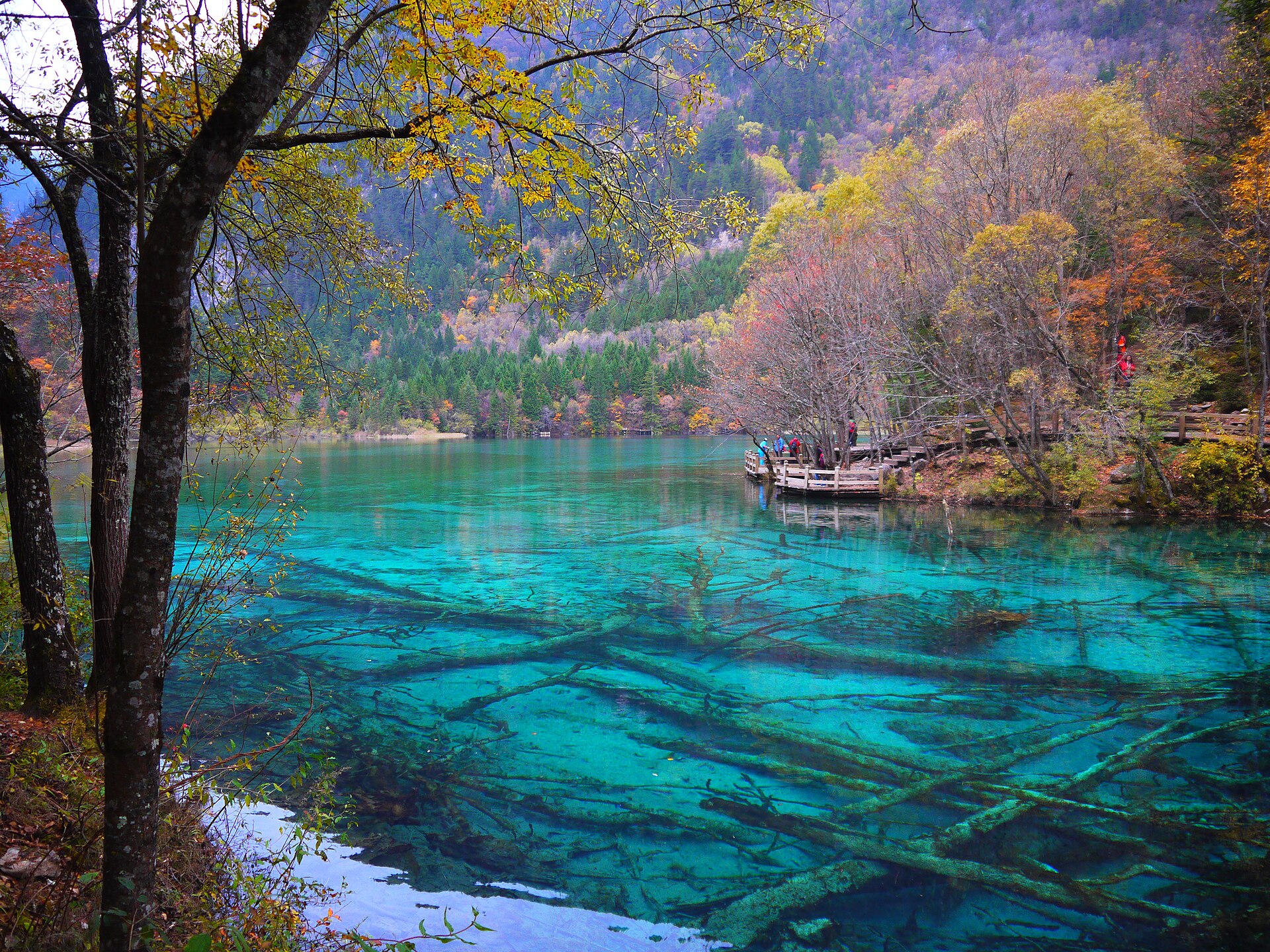
The valley’s famous terrace: peacock-bright shallows over fallen trunks, seen from boardwalks and the shuttle stops between them.
 Start your enquiry
Destinations / Jiuzhaigou
A valley of stacked travertine lakes so blue-green they look lit from below, falling through forest between 2,000 and 3,100 m. China’s most photographed water.
Explore the guide ↓Northern Sichuan · Southwest China
Jiuzhaigou — Nine Village Valley, after the nine Tibetan villages inside it — protects a chain of travertine lakes and waterfalls across roughly 720 km² of the Min mountains. The water picks up its colours from calcium carbonate, algae and depth, and no photograph quite settles the argument about them.
The valley reopened progressively after the 2017 earthquake and is now fully open, run on an internal shuttle system with boardwalks along the lakeshore. It is a walking park more than a wilderness: the scenery is the point, and the park manages it well.
Two hours away at similar altitude sits Huanglong, a limestone terrace of pools climbing toward 3,500 m. The two valleys are a natural pair — one day each — with the trip anchored on Chengdu or the horse country around Songpan.
What a Jiuzhaigou journey holds.
The valley’s famous terrace: peacock-bright shallows over fallen trunks, seen from boardwalks and the shuttle stops between them.
A 320 m curtain falls where the valley forks. Morning light puts a rainbow through it more often than not.
A two-kilometre stair of calcite terraces under the Xuebaoding snowfields. The walk is at 3,200–3,500 m — pace it.
Shuzheng, Heye and the villages of the valley keep stoned-timber farmhouses and prayer flags among the parks. The upper valley is still lived in.
Horse country and an old walled town on the way in — a quieter Sichuan that most visitors drive straight past.
The valley has four honest seasons; two are exceptional.
Autumn colour against full water is the valley at maximum. Expect the biggest crowds of the year and book everything early.
Spring water levels, fresh green forest and far fewer people. Cool mornings; some secondary walks still closed after winter.
Green and warm with afternoon rain. The crowds thin on weekdays and the waterfalls are at their loudest.
Connections, bases and the practical details that hold a good route together.
The rail line from Chengdu to Huanglong-Jiuzhai station has cut the old ten-hour drive to a few hours plus a transfer. Road access remains the fallback.
One ticket per day with a shuttle system between boardwalk clusters. A single day covers the main sights; two days let you walk the quiet lengths.
The valley mouth and Zhangzha town hold the hotels; Songpan suits travellers heading on to the grasslands. We book to the day plan, not the brochure.
Make room for local life, food and cultural encounters.
The nine villages’ households are Amdo Tibetan. Butter tea, whitewashed farmhouses and prayer flags sit inside the scenery — it is home first, park second.
The park towns serve honest Sichuan food at mountain-town prices; Chengdu bookends the trip with the good restaurants.
Songpan, the grasslands and Zhagana to the north offer the walking this region rarely gets credit for. Ask us about the extension.
Useful details to discuss when shaping your trip.
The park floor is 2,000 m; Huanglong tops 3,500 m. Take the boardwalks slowly, drink more water than feels necessary, and put Huanglong later in the trip.
Daily visitor caps and timed entries apply in every season. We secure park and Huanglong tickets before you travel.
Tell us whether the lakes are the whole trip or the opening act — we will build the route that treats both valleys properly.
Start my journey brief ↗