
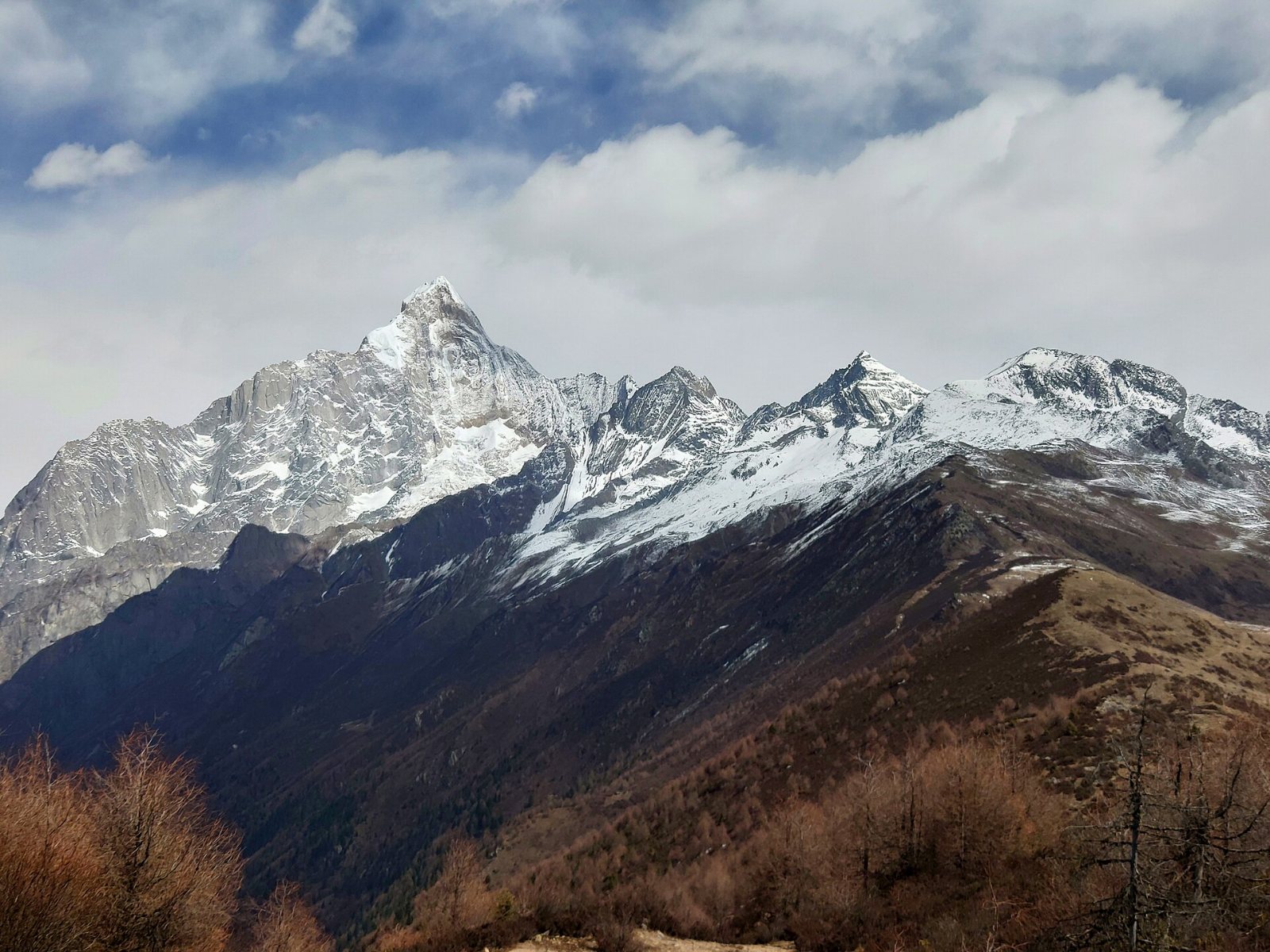
People ask this question as if there were a ranking. There is not. Siguniang and Yading sit at opposite ends of western Sichuan, at opposite ends of the effort spectrum, and at opposite ends of what a mountain trip is for. One is a range you look at and, if you like, climb. The other is a valley you walk into.
What follows is the comparison we would give a traveller who has one week in Sichuan and two names in mind.
Distance, and what it costs you
Siguniang is 175 kilometres from Chengdu, four hours by road, over the Balang tunnel. You can leave after breakfast and be at 3,200 metres before lunch. There is no airport and no railway, and that is the point: the approach is short enough to fit inside a long weekend.
Yading is a different proposition. The nearest airport, Daocheng Yading, is an hour’s flight from Chengdu and sits at 4,411 metres, the highest civil airport in the country. The alternative is two days on the 318 through Kangding, Xinduqiao and Litang, or an eighteen-hour coach. Either way you have spent two days of a week before you start walking.
In practice this decides more trips than any question of scenery. A three-day window is Siguniang. A seven-day window is either, and Yading is the one that uses the whole week.
Height, and how you get used to it
This is the least discussed difference and the one that ruins most Yading trips. Siguniang town is at 3,160 metres and you reach it by climbing 2,660 metres over four hours in a car. That is a jump, but it is a gradual one, and the valleys above it rise another 500 to 700 metres rather than another 1,500.
Yading puts you at 4,411 metres in an hour if you fly, then drops you to 2,900 for the night, then takes you back up to 3,900 inside the gate. The arithmetic of that is brutal for some people: the reserve’s own clinic sees it every week. If you are sensitive to altitude, Siguniang is the gentler mountain by a wide margin, and the difference is structural rather than a matter of fitness.
The walking
Yading is a single valley with two routes out of it: a short one to a lake below a peak, and a long one to two high lakes at 4,600 to 4,700 metres. The long route is the reason people go, it takes most of a day, and it is walked by almost everybody who visits. Nothing about it is technical. It is simply five hundred metres of climb at an altitude where that matters.
Siguniang gives you three separate valleys with three different characters. Shuangqiao is ridden on a bus. Changping is twelve kilometres of boardwalk and dirt to a meadow under a 2,500-metre wall. Haizi is meadow, then lakes, then the climbers’ path. You choose one a day, and the choice is real: a family, a photographer and an alpinist will each take a different one.
The consequence is that Siguniang rewards a longer stay with variety, while Yading rewards it with weather. At Yading you are waiting for a clear day on the same three peaks. At Siguniang, a bad day in one valley is a good day in another.
The seasons
Both are autumn places, and both are crowded in the first week of October. Beyond that they diverge.
Yading’s high route opens in mid-April and closes in late November, and the reserve treats those dates as a hard line. Winter is possible in the valley and not on the lakes. Siguniang never closes: Shuangqiao is ploughed all winter, the bus runs, and from late December the ice season fills the valley with climbers. November and January are the quiet months, and both are excellent.
Summer is the weak season at both, for the same reason: cloud sits on the summits from mid-morning. The difference is that Siguniang’s meadows are worth the walk on their own in July, and Yading’s long route is not worth doing in cloud.
Crowds, and what a day costs
Yading caps entry at about 15,000 a day and charges 146 yuan in peak season, with a compulsory shuttle. Siguniang caps at 20,000 and charges between 60 and 150 depending on the valley. Neither is cheap by Chinese standards and neither is quiet in October.
What differs is where the crowd goes. At Yading everybody walks the same valley in the same direction on the same timetable, so the first shuttle is a scrum and the long route is a queue at the steep sections. At Siguniang the crowd concentrates in Shuangqiao, because it is the valley that requires nothing. Walk one stop instead of riding it and you are alone; take Changping or Haizi and you are alone from the gate.
Which is yours
Take Siguniang if you have three or four days, if you are coming from Chengdu, if you want options rather than a single objective, or if you want to climb something. Dafeng at 5,025 metres is a guided snow walk with two days attached, and there is nowhere else in China where a first 5,000 is this accessible.
Take Yading if you have a week, if the photograph of three peaks above a valley is the thing you came to China for, and if you are willing to spend two days getting there and two getting back. It is the more dramatic landscape and the more demanding trip, and the two facts are related.
Do not take Yading as a two-day add-on to a Chengdu trip. People try, and they spend a day in a car, a night at altitude, four hours in the valley and a day getting out. Siguniang is the mountain that fits that shape.
Doing both, honestly
It is possible and it takes about ten days. The road between them runs from Xiaojin through Danba, Bamei, Tagong, Xinduqiao and Litang to Daocheng: roughly 700 kilometres, two long days, and some of the best driving in the province. Go Siguniang first, because it acclimatises you, and Yading second, because it does not forgive a bad first night.
What we would not do is the reverse. Flying into Yading at 4,411 metres and then driving to Siguniang gives you the hardest altitude of the trip on day one, which is exactly backwards.
If you only have one, and you are honest with yourself about how much walking you want to do, the choice is usually obvious within a minute. Siguniang is a place you visit. Yading is a place you go to.