
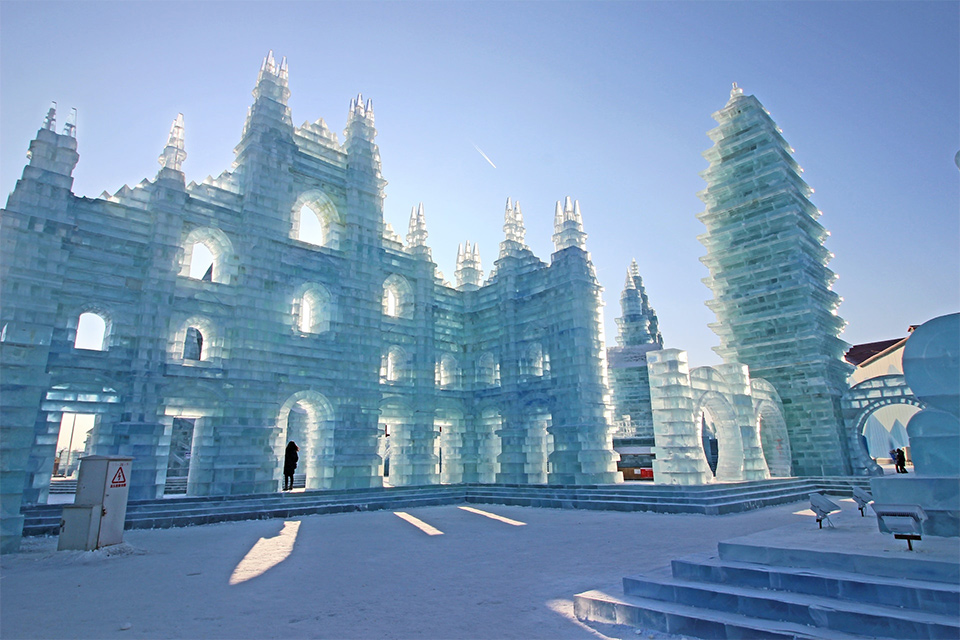
Cutting the ice.
The material comes from the river. We describe the work as quarrying by hand and machine: blocks are marked, cut from thick sheet ice, floated or hauled out, and stacked like stone. The cold that makes the city possible is also the cold the builders work in, and January in Harbin sits at roughly minus 15 to minus 30 degrees Celsius.
We treat ice as a serious structural material. The blocks are squared, graded, and laid in courses, with a little water used as mortar that freezes the joints solid. A wall goes up the way masonry goes up, except that every lift has to be true before the freeze sets it.
Building and light.
Light is designed into the structures rather than added at the end. We find the blocks are lit from within, so the walls glow through the ice and the whole building reads as a lantern after dark. That is why the site is best understood as a night place: in daylight the forms are pale and heavy, and at night the same forms become translucent.
The scale asks for an organised site. We plan a visit around the fact that these are built structures with edges, steps, and enclosed spaces, not an open snowfield. Paths, railings, and lit routes move people through them, and the surface underfoot is ice, so footwear and pace matter. We describe the cold as the main constraint on how long a group stays outside; the buildings are the reason to be there, and the temperature is the reason to keep moving.
A city of two months.
Everything about this place is temporary. We describe a city that stands for roughly two months and then is left to melt, which means the trip is organised around a window rather than a fixed attraction. The 28th Ice and Snow World has been announced for mid-December 2026, and the 42nd Ice and Snow Festival on 5 January 2027 is to be confirmed. Both are subject to weather and resort confirmation, and we re-check before dates are fixed.
So the season decides the itinerary. We would rather build a trip with slack in it than pin every day to an opening that a warm spell can move. When the site is open we give it the evening it asks for, and we keep indoor time in reserve for the coldest hours. The honest description is of a working season, not a permanent sight: a city assembled by builders, lit for a short winter, and gone by the thaw.
Keep reading
Ice on the river
The winter table
Spring Festival snow