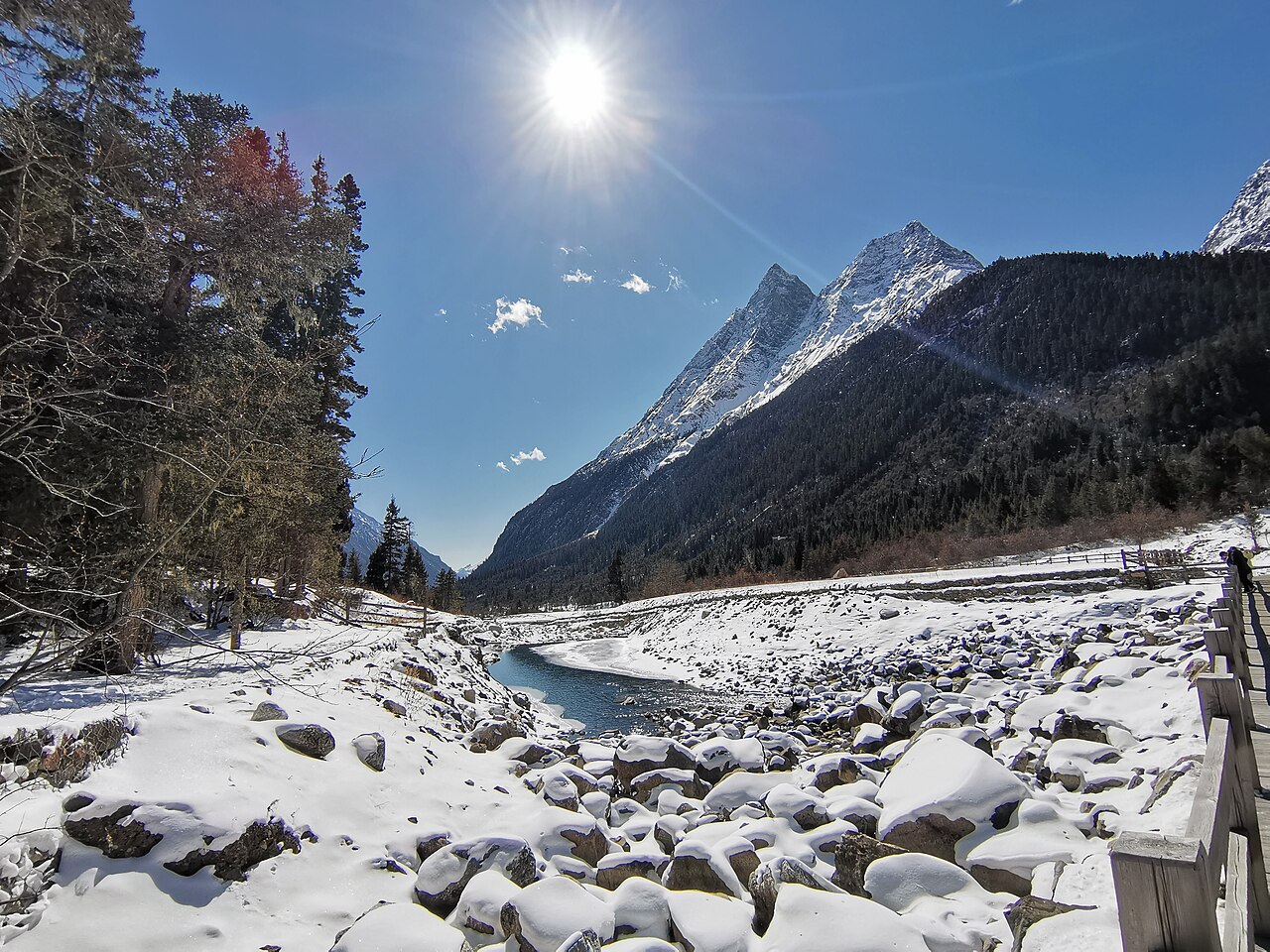
A hundred falls, one valley road.
In summer the side streams of Shuangqiao run as ordinary water. From mid-December they hang as ice, and the valley becomes the most concentrated climbing venue in China.
The scenic area authority counts more than 100 natural icefalls on the two sides of the valley, of which roughly 30 are described as experience-grade — short, accessible, and suitable for instruction. The remaining walls run from WI3–4 up to WI5, and include multi-pitch faces of several hundred metres. Independent operators put the usable total in the same range, which is rare agreement in this business.
What makes the valley work for a short trip is the geometry. Published approach distances run from 350 m to 950 m from the valley road, so a climbing day is mostly climbing. You are not committing to a glacier approach to climb thirty metres of ice, and you can change walls between days without changing base.
It also has a competitive history. The Siguniangshan International Ice Climbing Festival has run every New Year since 2010, with competition climbing on the Wuse wall, free-climbing sessions, technique clinics and a skills programme for beginners. That is the reputation. It is worth saying plainly that a reputation is not a conditions report: what you find on a given wall in a given week depends on how that winter has formed, melted and refrozen.
The twelve named walls.
The scenic area publishes twelve named walls with measured data. They are the most reliable planning numbers available, and they show how the valley is organised: a teaching wall at 8 km, the mid-valley WI3–4 cluster around 13–18 km, then progressively bigger and harder objectives toward the roadhead.
Swipe the table sideways to see every column.
Published wall data · Siguniangshan scenic area authority
| Wall |
Km from gate |
Walk from road (m) |
Height (m) |
Altitude (m) |
Ice angle |
Grade |
Lines |
| Wuse五色 |
8 |
360 |
30 |
3,300 |
75° |
WI3 |
2 |
| Guangxian No.1光纤一号 |
13 |
430 |
30 |
3,478 |
80–90° |
WI4 |
1 |
| Shenxiandong神仙洞 |
13 |
610 |
35 |
3,433 |
70–80° |
WI3–4 |
1 |
| Baiyangou白岩沟 |
14.3 |
600 |
28 |
3,382 |
70–80° |
WI3–4 |
2 |
| Mutizi木梯子 |
14.3 |
800 |
50 |
3,450 |
70–80° |
WI3–4 |
2 |
| Dashibao大石包 |
18 |
950 |
28 |
3,441 |
80° |
WI4 |
2 |
| Chibang翅膀 |
23 |
820 |
120 |
3,550 |
80°+ |
WI4+ |
2 |
| Shuiliandong水帘洞 |
25 |
820 |
20 |
3,600 |
75° |
WI3 |
2 |
| Nianyuba撵鱼坝 |
25.5 |
800 |
200+ |
3,600 |
80° |
WI4 |
2 |
| Xueshan Laowu雪山老屋 |
26 |
650 |
500 |
3,630 |
80°+ |
WI5 |
2 |
| Da Yangtianwo大仰天窝 |
27 |
350 |
500 |
3,650 |
60–80° |
WI3–4 |
1 |
| Baihaizi白海子 |
29 |
800 |
300 |
3,750 |
60–80° |
WI3–4 |
1 |
Shaded rows are the two walls the authority names as suitable for teaching and first attempts. “Lines” is how many ropes can be rigged at once, not how many routes exist on the wall. Heights above about 120 m describe multi-pitch valley walls, not a guided single-pitch day.
How to read this table
- Km from gate is where you leave the shuttle or vehicle. The valley is a single road, so this is also your travel time inside the valley.
- Walk from road is the approach each way. 350 m is ten minutes; 950 m with a pack in snow is a different start to the day.
- Grade describes the published line at normal conditions. A WI3 wall can carry harder ice in a lean year, and a WI4 wall can be friendlier when it is fat.
- Altitude matters more than most visitors expect. Every wall here is higher than the town you sleep in.
If your experience is a handful of indoor sessions or one winter day at a dry-tool wall, the honest target is a WI3 teaching wall with a top-rope, not the named WI4 lines. Progression here is fast enough when the first day is built correctly.
Season: a two-month window, not a winter.
The scenic area publishes the climbing window as mid-to-late December through the end of February. The national sports administration’s venue note describes December to March as the golden period, which reflects the longer, colder tail some years allow. Recent seasons have opened with an official announcement — 2025–26 began on 25 December at the Wuse wall — so treat the opening date as something to confirm rather than assume.
What the weather actually does
Winter days here are often clear and still, and on a sunny wall the air can reach around 10°C at midday. That is comfortable for climbing and less comfortable for ice: direct sun softens the surface, and a warm afternoon can turn a firm line into a wet one. Cold, dry, shaded walls in the mid-valley usually hold better than the sunny teaching wall late in the day.
- Best odds: late December to early February, with cold nights and no recent thaw.
- Marginal: a warm spell, strong wind, or fresh snow loading the slopes above a wall. These are the days a good guide changes the wall, changes the hour, or changes the plan.
- Busiest: the New Year week around the festival. Accommodation and guides go first, and the teaching walls are shared.
- Late season: ice thins, some lines close, and the valley can be at its most beautiful and least reliable.
What the WI numbers mean here.
Water-ice grades describe the steepness and continuity of a frozen line in good condition, not its length, exposure or how well it is protected. In Shuangqiao the grade range maps fairly neatly onto the valley:
- WI3 — sustained ice in the 70–80° range with short vertical steps. Wuse and Shuiliandong are the teaching walls; this is where a first day belongs.
- WI3–4 — the mid-valley cluster: Baiyangou, Mutizi, Shenxiandong, and higher up Da Yangtianwo and Baihaizi. Vertical sections appear, and the approach gets longer.
- WI4 — Guangxian No.1 at 80–90°, Dashibao and Nianyuba. Near-vertical climbing with fewer rests than a WI3 line.
- WI4+ and WI5 — Chibang at 120 m, and Xueshan Laowu, which the authority lists as professional-level terrain.
Our ice-climbing page carries a full WI1–WI6 table with what each grade asks of you and which Chinese walls correspond to it. Read it before deciding that a number sounds manageable.
Getting there, and the altitude you are buying.
The scenic area gives the distance from Chengdu as 220 km; the sports administration’s venue note says 260 km. Either way it is a half-day drive of roughly four to five hours through the Balang Pass tunnel, and the last stretch climbs steadily to the town at about 3,200 m.
- Base: Siguniangshan town (Rilong), around 3,200 m. Guesthouses with heating; most climbing trips stay here and shuttle into the valley each morning.
- Inside the valley: access is by the scenic area shuttle. Walls are then 350–950 m from the road, on foot.
- Climbing altitude: 3,300 m at Wuse up to 3,750 m at Baihaizi — higher than anywhere you will sleep on this trip.
- Winter roads: snow and ice on the pass section can delay a transfer. A buffer day at the end is cheaper than a missed flight.
Altitude is the part most fit travellers underestimate. You are not climbing at 3,400 m all day, but you are walking, carrying and recovering there, sleeping at 3,200 m, and doing it in cold air. A day of adaptation before the first wall changes the whole week, and it is the first thing we build into a plan rather than the first thing we cut.
Guiding, tickets and the rules that apply.
Ice climbing here is managed as an outdoor activity, separately from sightseeing. The scenic area runs a guide service through an affiliated climbing school, working at one or two climbers per guide — a ratio that makes a difference on a teaching wall where someone has to check your crampons and your knot before you leave the ground.
- Tickets: expect park entry, the valley shuttle and an ice-climbing ticket, rather than one general admission. The operating team arranges these as part of a guided booking.
- Registration: the valley runs a checkpoint and an outdoor activity centre. Confirm the current registration requirement for your dates when you book, rather than assuming last season’s arrangement still applies.
- Equipment: ropes, screws, tools, crampons, harness, helmet, belay device, slings and prusiks come through the guiding team, usually fitted the day before. Boots that accept crampons are the one item worth sorting early.
- Published safety notes: assess the terrain and ice quality before climbing, avoid warm or windy days, wear helmet, harness and waterproof warm gloves, watch for falling ice, and place tools without over-swinging — a levered tool cracks the ice you are standing on.
Two shapes of trip, and what we arrange.
Almost every enquiry we get about Shuangqiao falls into one of two groups: a first, taught day on ice, or a week of progression with a bigger wall as the aim. They are not the same trip and should not share an itinerary.
Introduction · 3–4 days
One adaptation day, one full day on a WI3 teaching wall, one flexible day that can repeat the teaching wall, move to a short WI3–4 line, or become a snow-and-valley day if conditions turn.
- For
- No ice experience required; reasonable fitness and a tolerance for cold.
- Builds
- Crampon and tool technique, rope-safety basics, reading ice, an honest sense of what WI4 asks.
- Risk
- Weather eats a day. We keep the second climbing day movable rather than booking two walls in advance.
Progression · 5–7 days
A graded block through the mid-valley cluster: WI3 to warm up, then WI3–4 on Baiyangou or Mutizi, then a WI4 objective such as Guangxian No.1 if the skills and the ice both agree.
- For
- Climbers with previous ice or mixed experience, comfortable leading or following on steep ground.
- Builds
- Efficiency on steep ice, screw placement and belays, decision-making, multi-pitch exposure if it fits.
- Risk
- Ambition outrunning the season. The named objective is a target, not an entitlement.
What we arrange
- Guiding at the scheduled ratio, booked with the valley’s own service, with fit and kit check the day before.
- Park entry, shuttle and ice-climbing tickets, and the registration the current season requires.
- Accommodation in the valley and in town, transfers from Chengdu, and a vehicle on standby days.
- A plan written around conditions: which wall on which day, which day moves if the ice does not cooperate.
- The honest conversation about whether your target wall matches your current level — before you book flights, not after.
We do not guarantee a specific wall, a summit or a grade. Ice is a moving surface, and the judgement to change the plan is part of what you are paying a guide for.
A four-day outline.
This is a planning shape to adapt, not a fixed departure. Arrival day, group altitude history and the season’s condition report all move it.
- Chengdu → Siguniangshan, 3,200 mRoad transfer over the Balang Pass, kit check and boot fitting, short walk in the afternoon, early night.
- Valley day one — Wuse, WI3Shuttle to 8 km, ten-minute walk, movement coaching on low-angle ice, top-rope laps, then an honest debrief over dinner.
- Valley day two — mid-valley WI3–4Baiyangou or Mutizi, longer pitches and a bigger approach, more independent climbing with the guide close by.
- Weather buffer, then returnA movable day: a third climbing day, a WI4 attempt if it fits, or the drive back with time to spare.
Before you book.
- Your ice or mixed experience described plainly, including what you have led and what you have only followed.
- Each traveller’s altitude history, and any heart, blood-pressure or respiratory condition we should know about.
- Boots: whether you have crampon-compatible boots, or need them fitted in the valley.
- Dates with at least one movable day inside the window, and flexibility at either end of the trip.
- A realistic view of the cold — this is a winter mountain valley, not a resort.
- What else the journey should include, so the climbing block sits sensibly inside it.
Questions we get asked.
Do I need previous ice-climbing experience?
Not for the teaching walls. Wuse (WI3, 30 m, 8 km from the gate) and Shuiliandong (WI3, 20 m) are the two the scenic area names as suitable for instruction and first attempts, and a guided day there starts with crampon and tool technique on low-angle ice. Anything at WI4 and above assumes you can already place tools and kick steps with some economy, and the multi-pitch walls — Chibang, Nianyuba, Xueshan Laowu — are a different commitment altogether.
How fit do I need to be?
Ice climbing itself is short bursts of effort, but the day around it is not. Approaches run from 350 m to 950 m one way, often in snow, carrying a pack with rope and hardware, and the walls sit between 3,300 m and 3,750 m. If you can walk uphill for an hour at altitude with 8–10 kg and still have something left, you are in the right range for a WI3 day.
What does the altitude do to a trip?
The base town sits around 3,200 m, and you climb higher than you sleep. Most travellers arriving straight from Chengdu feel the first day. We build in an adaptation day, keep day one short and low, and treat headache, nausea or broken sleep as a reason to change the plan rather than push through it. Nothing on this page is worth a night of altitude illness.
Can I climb without a guide?
Ice climbing here is managed as an outdoor activity rather than ordinary sightseeing, and the scenic area runs its own guide service through an affiliated climbing school at one or two climbers per guide. Independent climbers with the right experience and insurance do visit, but the current registration and ticket arrangements need checking with the outdoor activity centre before you assume you can simply walk in and climb. On our trips the guiding is booked as part of the plan.
What equipment is supplied, and what should I bring?
Technical equipment — ropes, ice screws, tools, crampons, harness, helmet, belay device, slings and prusiks — normally comes through the guiding team, with fitting done the day before. Bring your own boots if you have them and they take crampons; otherwise confirm sizes in advance. Personally, the layers matter more than the hardware: a shell, a warm mid-layer, spare gloves, goggles, high-factor sunscreen and a flask.
When is the ice actually in condition?
The scenic area publishes the climbing window as mid-to-late December to the end of February, and the national sports administration’s venue note describes December to March as the golden period. Within that window, ice forms, fattens and then deteriorates; warm spells, direct sun on south-facing walls and wind all change a line from one week to the next. The season opening date is announced each year — the 2025–26 season opened on 25 December at the Wuse wall.
Is it dangerous?
It is a mountain activity with real objective hazards: falling ice, cold injury, avalanche runouts under loaded slopes, and the ordinary risk of swinging sharp tools next to a partner. Good practice — a guide who knows the wall, helmets, fixed belays, an honest read of the ice and a turnaround time — reduces but does not remove that. We do not describe any ice climb as safe; we describe how the risk is managed.
Can this be part of a longer Sichuan trip?
Yes, and it usually should be. Chengdu, the panda bases and the Siguniang trekking valleys sit on the same road, so a climbing block of three or four days slots into a two-week journey without a second long transfer. Tell us what else you want to see and we will shape the order around the season rather than the other way round.
References & photography
- Siguniangshan scenic area authority, Outdoor ice climbing — published wall data, season window and guide service.
- Siguniangshan scenic area authority, International ice climbing festival — festival history since 2010 and event programme.
- Siguniangshan scenic area authority, 2025–26 season opening — season launch on 25 December 2025 at the Wuse wall.
- General Administration of Sport of China, Ice-climbing venue notes (PDF) — December–March golden period, winter temperatures, Chengdu distance.
- Siguniangshan scenic area authority, Why Shuangqiao remains an ice-climbing destination — valley length, icefall counts, ice forming from mid-to-late December.
- Photo: Shuangqiao Valley, Mount Siguniang — Polyphys, CC BY-SA 4.0. Resized for display.
The wall measurements, season window and guide ratio on this page come from the sources above. Route choices, trip shapes and the four-day outline are our planning suggestions. Conditions change every season: confirm the current situation with your guide before travelling.