
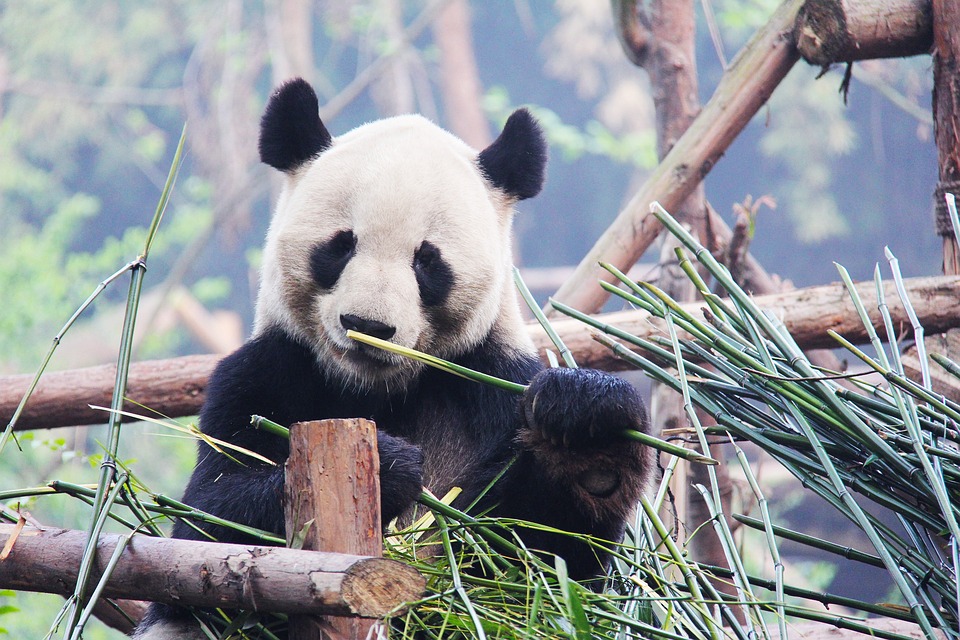
China's fourth national panda survey, published from fieldwork in 2015, counted 1,864 wild giant pandas across six mountain ranges. The Giant Panda National Park, formally established in 2021, covers roughly 22,000 km² across Sichuan, Shaanxi and Gansu; by the park's own five-year reporting in 2026 it protects nearly 1,400 wild pandas, more than 70% of the national total, with 1,227 of them in the Sichuan section.
Those figures are not additive — they come from different baselines and different boundaries, and anyone quoting a bigger number by adding them is selling something. What they describe is a species that has recovered enough to be reclassified from Endangered to Vulnerable in 2016, and is still made up of small, separated populations in dense forest.
The arithmetic of a sighting.
Set the numbers against the map and the difficulty becomes obvious. The Sichuan section of the park alone is about 19,300 km². Even if all 1,227 of its pandas were spread evenly — which they are not — that is roughly one animal per 15 km² of mountain forest, in terrain with 1,500 metres of vertical relief, bamboo thickets you cannot see through, and animals that avoid people by choice.
Add the structure of the population: the 2015 survey found the pandas split into 33 isolated groups, 22 of which held fewer than 30 individuals. Small populations in fragmented habitat are hard to find precisely because there are so few of them in any one place.
This is why a wild sighting is not a product you can buy with confidence. What you can buy is a well-planned attempt with a guide who knows one valley, in the right season, with enough days for the attempt to survive two blank ones.
Four places, four different days.
The facilities around Chengdu are not interchangeable, and the differences are practical rather than philosophical:
- Chengdu Research Base — the one everyone visits, on the edge of the city. Adult tickets ¥55, students ¥27, a daily cap of 85,000 visitors and mandatory online real-name reservation. Hundreds of animals in large landscaped enclosures, plus red pandas. Convenient, reliable, busy.
- Dujiangyan Panda Valley — about an hour from Chengdu, ¥55, a smaller site with roughly twenty animals and a fraction of the crowd. A good half-day, and easy to combine with Dujiangyan or Qingcheng Mountain.
- Wolong, Shenshuping base — around 100 km and two hours into the mountains, at about 1,700 m, ¥85. Seventy to eighty animals including cubs of different ages, in a forested reserve setting that is part of the Sichuan Giant Panda Sanctuaries World Heritage Site. A full day, and the one to choose if the setting matters as much as the animal.
- Bifengxia, near Ya'an — around 160 km, ¥95–110 including the scenic area, seventy-plus animals plus a gorge. A full day, best done with a night nearby rather than as a return trip.
Tickets are not shared and there is no combined pass. Doing two sites in one day means paying twice and seeing less of both.
The hour matters more than the ticket.
Pandas eat in the morning and sleep through the middle of the day. The Chengdu base opens at 7:30 from March to October and 8:00 from November to February, with morning tickets admitting until noon and the park clearing from 17:30 or 18:00 depending on the season. Arriving at opening and leaving by eleven will show you more activity than arriving at ten and staying until closing.
Reservations open 14 days ahead through the official WeChat channels and authorised platforms, and the daily quota does sell out — particularly at weekends and during public holidays, when the queue for the most famous animals can run to an hour or two for a few minutes of viewing. Book as soon as your dates are fixed, and take the earliest slot you can bear.
Verify before you commit.
Panda facilities close, and not always with much warning. The Dujiangyan centre (not Panda Valley) has been closed for renovation since 23 April 2026, with no reopening date published at the time of writing. Anyone working from a year-old itinerary would arrive at a locked gate.
The same caution applies to Wolong, where access arrangements have changed repeatedly since the 2008 earthquake, and to any reserve where a new road, a landslide or a change of operator can alter what is possible in a given week. Confirm the specific facility for your specific dates through official channels — not through a booking site that has not updated its page.
What not to buy.
Direct contact with pandas has been stopped at the main centres, and any product offering to hold a cub, feed an adult or photograph a group with an animal in its lap should be treated as a warning rather than an upgrade. The same applies to "volunteer" programmes: some are genuine husbandry-support days with no animal contact, others are a photograph with a keeper's uniform. Ask what the day actually involves before paying.
In the reserves, the rules are simpler. Stay on the boardwalk, keep quiet, do not feed anything, and do not ask a guide to leave the trail for a better angle. A panda that becomes habituated to people is a panda that stops being wild, and the reserve exists for the second thing.
A real attempt in the wild.
If you want to try, the strongest option is not in Sichuan. Foping National Nature Reserve in the Qinling Mountains of Shaanxi holds one of the highest densities of wild pandas, and in winter and early spring the animals move to lower elevations where they are marginally more findable. Specialist operators work there with local trackers. The Qinling population is also a recognised subspecies, slightly browner in the coat than its Sichuan relatives.
In Sichuan, Tangjiahe and Labahe offer genuine panda habitat and excellent general wildlife — takin, tufted deer, golden snub-nosed monkeys and pheasants are realistic sightings around valleys such as Baixiongping — but pandas themselves are seldom seen. Anyone who tells you otherwise is describing the habitat, not the animal.
A serious attempt means four or five days minimum, a local guide, winter or early spring, binoculars rather than a long lens, and a willingness to walk slowly and stop often. It also means accepting that a week can end with tracks, droppings and no panda, and that this is a normal result rather than a failure of the guide.
Choosing between them.
If the panda is the reason for the trip, go to a facility — Chengdu for convenience and volume, Wolong for setting, Panda Valley for quiet. Book early, arrive at opening, and treat the rest of the day as separate.
If the panda is one interest among several, put a facility day at the start of a Sichuan journey and spend the saved days in the reserves looking at everything else: takin on a forest slope, monkeys in a winter tree, a valley with no one in it. That is a better trip than five days of chasing a probability, and it is the version most people actually remember.
Population figures, park boundaries, ticket prices, opening hours and closure status checked 3 November 2026 against Sichuan provincial government reporting, the Chengdu base's own ticket page and published reserve guidance. Facilities and quotas change — confirm the site and its hours before travelling.
Wildlife is one of the reasons we build routes the way we do.
See how a wildlife journey works →