
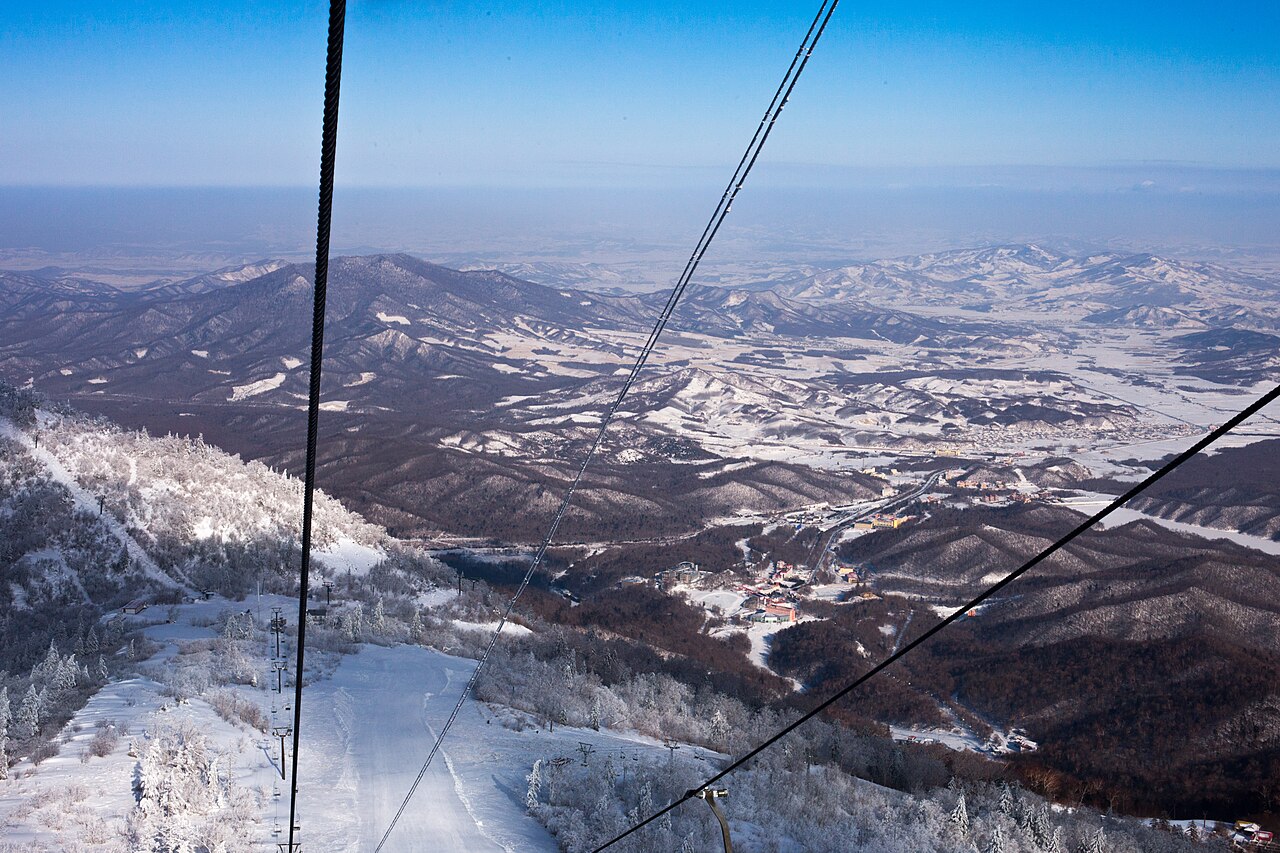
Skiing in China gets discussed as though it were one product — usually by someone who has been to Harbin in January and formed an opinion about the whole country. In practice the three main regions are as different as Austria, Colorado and Hokkaido: different snow, different vertical, different access, and different reasons to go.
The good news is that the differences are easy to state. The bad news is that most people plan backwards, choosing a city first and then looking for snow near it.
Three regions, three trips.
- Chongli, Hebei — 2022 Olympic venues, snowmaking-dependent, fast lifts, an hour by high-speed rail from Beijing. Season from late October to early April.
- Jilin — colder, drier, longer vertical, quieter slopes. Season from early November to mid-April. Reached by flying to Changchun or Jilin, or by rail from Harbin.
- Xinjiang, around Altay — light dry powder, the biggest vertical in the country, and the earliest opening. Season from mid-October to late April, at the cost of a four-to-five-hour flight from Beijing.
Chongli: the Olympic option.
Chongli is the easiest snow holiday in China to reach. Trains run from Beijing North to Taizicheng in about an hour and twenty minutes on the slower D services for ¥79, or an hour and twenty-five on the G trains for ¥99, and free shuttles cover the five to twenty minutes from the station to the resort clusters. Land in Beijing in the morning and you can be on a chairlift after lunch.
Nine resorts share the valley, but three do most of the work, and they are not interchangeable:
- Wanlong — the most serious mountain of the three, with 554 m of vertical across 32 runs and 47 km of piste, and the longest single drop in Chongli. Day tickets ran ¥560–800 last season and night skiing ¥189–289. It opened on 23 October in 2026, weeks ahead of its published plan, after an early cold snap let the snow guns run.
- Thaiwoo — 510 m of vertical over 31 runs and 30 km of piste, five to ten minutes from the station, with a purpose-built village where the hotel, coffee and rental shop are all within a two-minute walk. Lift prices were lower than Wanlong last season — ¥299 midweek, ¥339 at weekends — and a beginner lesson is published at ¥600 for two hours. It opens on 13 November in 2026.
- Genting Secret Garden (Yunding) — the competition venue, 398 m of vertical over 32 runs and 28 km of piste, 5.1 km from the station, and the most useful of the three for anyone holding a multi-resort pass. Lift-only day tickets were ¥418 last season, ¥598 with gear. It opens on 6 November in 2026.
The honest limitation is the snow. Chongli can have an excellent base by December and still be a manufactured one. That matters less than it sounds for piste skiing — the grooming is good and the lifts are fast — and more than it sounds if you came for powder.
Jilin: the vertical.
Jilin is where Chinese skiers go when they care about the mountain rather than the resort village. Beidahu has 870 m of vertical, the most of any lift-served area in the country, and day tickets ran ¥360–840 last season. The season is longer than Chongli's, running from early November to mid-April, and the slopes are quieter outside the Spring Festival.
Yabuli, in Heilongjiang, is the other classic, and the easiest to combine with Harbin. Trains from Harbin to Yabuli West take as little as an hour and four minutes for ¥76 in second class. The Yangguang area has 17 runs over 32 km of piste, with a longest run of about 5 km and close to 900 m of drop. A day of skiing followed by an evening at Harbin's ice festival is one of the better winter combinations in the country — and it is the reason not to write off the northeast just because the resorts are older.
Xinjiang: the powder.
Altay, in the far north-west, is the reason serious skiers now fly four hours past Beijing. Keketuohai has 1,350 m of vertical and Jikepulin 1,466 m — more than double Chongli's biggest — with light, dry snow that needs very little snowmaking. The season starts in mid-October, when the rest of the northern hemisphere is still waiting.
What it does not have is infrastructure in English. Outside the larger hotels, expect less English on the ground than in Chongli, longer transfers in serious cold, and a much thinner margin if something goes wrong. Go with time, and go for the snow.
Season and the holiday crush.
Chongli runs from late October to early April, with December to February the reliable core. Jilin runs from early November to mid-April, Xinjiang from mid-October to late April. Early season means limited terrain open, whatever the marketing says — a resort that opens on 23 October may have three runs and one lift running.
January gives the most reliable cold and the shortest lift queues, except during Spring Festival, when Chinese New Year moves the entire country at once: hotel rates can triple and the main runs become a queue with a view. If your dates fall on the holiday, book two months ahead or shift by a week. December and early March are the sweet spots.
What a day costs.
Lift tickets range from roughly ¥299 at the cheaper Chongli resorts on a weekday to ¥800 at Wanlong at peak, with Jilin between ¥360 and ¥840. Equipment rental is usually ¥80–180 a day for skis and boots; bring your own helmet and gloves, because rental stock is basic. Private lessons run ¥400–800 for two hours, and English-speaking instructors exist at Thaiwoo and at the larger Jilin hotels but need to be booked ahead.
Packages are where the savings are. A hotel-plus-lift bundle in peak weeks typically costs 15–30% less than booking the parts separately, and slopeside hotels run ¥900–1,800 a night mid-tier in high season, with town accommodation 30–50 minutes away at a third of the price. If you ski half-days, stay in town.
Booking the pieces.
Three things book out, in this order: the train, the slopeside room, and the instructor. Chinese rail tickets go on sale 15 days ahead and the Saturday morning trains from Beijing to Taizicheng are the first to go — book the outbound and return on the day the window opens, not when you reach Beijing. Lift passes and hotels sell out for weekends and the Spring Festival; resort WeChat accounts often have inventory the OTAs do not.
Finally, be honest about level when you book. Chongli's beginner terrain is wide and well served, which makes it the right choice for a first week on snow, and Jilin's vertical is wasted on anyone still learning to turn. A two-hour lesson on the first morning is the best value in the entire trip, at any of the three regions.
Vertical, run counts, ticket prices, season dates and rail fares checked 3 November 2026 against resort-published 2026–27 season information and current rail timetables. Opening dates and prices change with snow and demand — confirm with the resort before booking.
Snow days can anchor a winter journey.
See how we plan ski trips in China →