
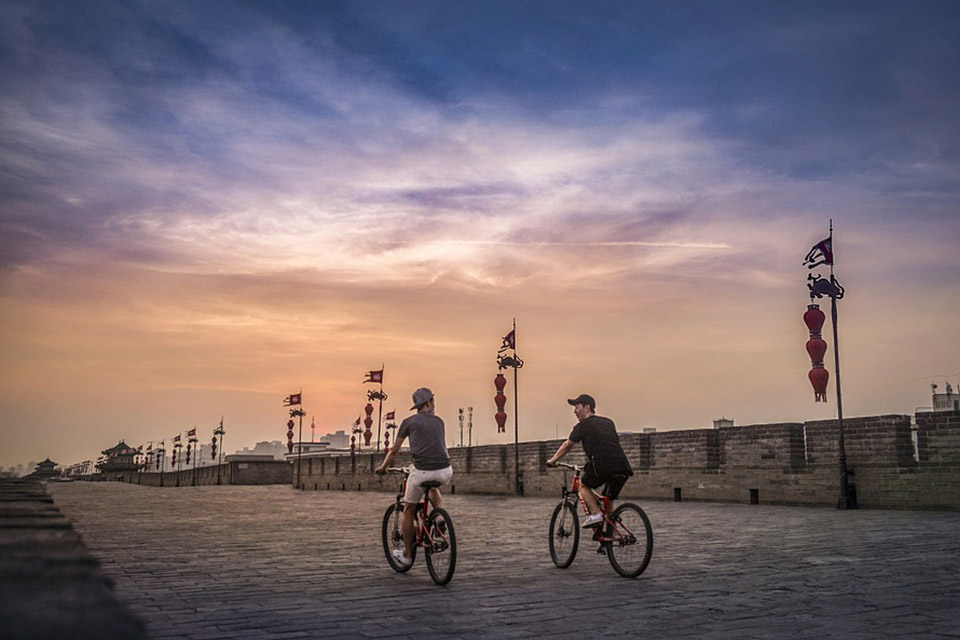
Most cycling enquiries start with a number: eighty kilometres a day, or a thousand over two weeks. It is the least useful thing to begin with. A hundred flat kilometres on an empty lane beside a lake is a pleasant morning. Twenty-five kilometres on a provincial road with coal trucks is a bad afternoon, and no amount of fitness fixes it.
The questions that decide whether a route works are duller and more important. Is there a minor road, or only the highway? What is the surface? Is the climbing concentrated in one pass that has to be ridden, or spread out? Where is the bed at the end of the day, and can the van reach it?
Ask about the road.
China's road hierarchy matters more than its topography. Expressways are closed to bicycles entirely, which is good news — it removes the temptation. The roads worth riding are the county and village roads that connect farmland, and they exist in great number wherever the terrain has kept the highway on a viaduct.
Two things to know before planning around a map that looks quiet. First, Chinese maps often show a road that is now a construction site, or a track that is impassable after rain. Second, a road can be perfectly good and still be the only route for every quarry lorry in the district. Local knowledge of the current state of a road is worth more than any planning tool, which is why the first day of a route should be checked by someone who has driven it this season.
Four regions that work.
These are not the only options, but each has a reason to exist that is not marketing:
- Erhai Lake, Yunnan — a loop of roughly 120 km around the lake at about 1,970 m, between Dali's old town and the villages on the far shore. Two or three easy days, plenty of accommodation, and the Cangshan range as a backdrop. The classic windows are March to May and September to November.
- Qinghai Lake — 360 km around China's largest lake, with the water surface at 3,200 m. The road is excellent because a professional stage race uses it, and the circuit is usually ridden clockwise to follow local custom. July and August are the only comfortable months, with rapeseed in flower along the shore in mid-to-late July. Four to seven days.
- Hainan's east coast — roughly 300 km from Haikou towards Sanya on the tropical side of the island, with low elevation, palm groves and warm rain. November to March is the season; summer heat and autumn typhoons are not. Three or four days if you ride the east coast only.
- The karst lanes around Yangshuo — 20–35 km days on flat farm tracks between limestone towers, past the Yulong River and the villages north of town. Not a tour, an afternoon. It is also the best place in the country to test whether your family actually enjoys cycling.
Honest daily distances.
For a rider who cycles occasionally at home, 40–55 km a day on flat sealed roads is a comfortable rhythm that leaves time to stop. For regular riders, 70–90 km is sustainable over a week. Add climbing and the numbers drop sharply: 100 metres of ascent per 10 km of route is a rolling day, and anything above that starts to be the point of the day rather than a feature of it.
Above 3,000 m, cut the daily distance by a third for the first three days and do not plan a pass on arrival day. The riders who enjoy Qinghai Lake are the ones who gave themselves a short first afternoon.
Bikes, rental and your own.
Rental quality varies by region and by shop, and it is the single most common disappointment. Around Yangshuo and Dali you can rent a usable mountain bike for roughly ¥35–50 a day, or an electric bike for ¥50–100; in Xining, hybrid and gravel rental runs about ¥80–120 a day, often with a repair kit. Road bikes in the right size are much harder to find outside the big cities.
If you are riding more than a few days, bring your own saddle, pedals and shoes — they fit in a suitcase and transform a rental bike. Bringing a whole bicycle is possible but adds a bike fee on most flights, a transfer problem at each end, and the risk of damage; for a week or less, a good rental plus your own contact points is usually the better trade.
On trains, a bicycle is luggage rather than a passenger. A folding bike in a bag travels without fuss; a full-size bike generally needs to be boxed and may be refused at busy stations. Plan the transfer as a van move, not a rail move.
Support and luggage.
The difference between a self-guided feel and a supported ride is one vehicle. A van that carries bags, water and a spare wheel, meets you at lunch and can collect a rider who has had enough removes most of the ways a cycling trip goes wrong — and it does not remove the sense of riding your own route.
Luggage transfer is the other quiet luxury. Riding with two panniers is a different holiday from riding with nothing, and on a route with one big pass, the difference decides whether the day is enjoyable. If you are moving hotels daily, the bag should move in the van; if you are based in one place for three nights, it does not matter.
Season windows.
The four regions above have almost no overlap, which is useful: something is rideable in almost every month. Erhai in spring and autumn, Qinghai Lake in July and August, Hainan from November to March, Yangshuo from April to October — though July and August there are hot enough that the riding is over by eleven.
Two seasonal traps deserve mention. Qinghai's weather changes fast, and a sunny morning at the lake can end in sleet in July; pack a shell and gloves whatever the forecast says. Hainan's typhoon season runs through the late summer and autumn, and a ferry or a flight can be cancelled for two days with little notice.
What actually goes wrong.
Not the dramatic things. The common failures are a saddle sore on day three, a bike that was the wrong size from the start, heat exhaustion on an exposed afternoon, and a route that ended after dark on an unlit road. Night riding on rural roads without lights is genuinely dangerous, and the plan should end each day with daylight to spare.
Three local specifics. Rural dogs chase bicycles, and the reliable response is to keep riding and not to stop; a water bottle aimed at the ground behind you usually ends it. Tunnels appear without warning on mountain roads, so a rear light is not optional even in daylight. And helmets are not universal locally, but on roads shared with trucks they should be non-negotiable for a visiting group.
Hydration is the last one. On the plateau the air is dry enough that you will not notice you are sweating, and the first symptom of altitude dehydration is usually a headache the next morning. Two litres on the bike, not one.
Distances, elevations, seasons and rental ranges checked 3 November 2026 against regional tourism guidance, route databases and local operator pricing. Road conditions, rental fleets and access change — the state of a specific road is a question for someone who has driven it recently.
A cycling route is built around the road, not the map.
See how we plan cycling journeys →